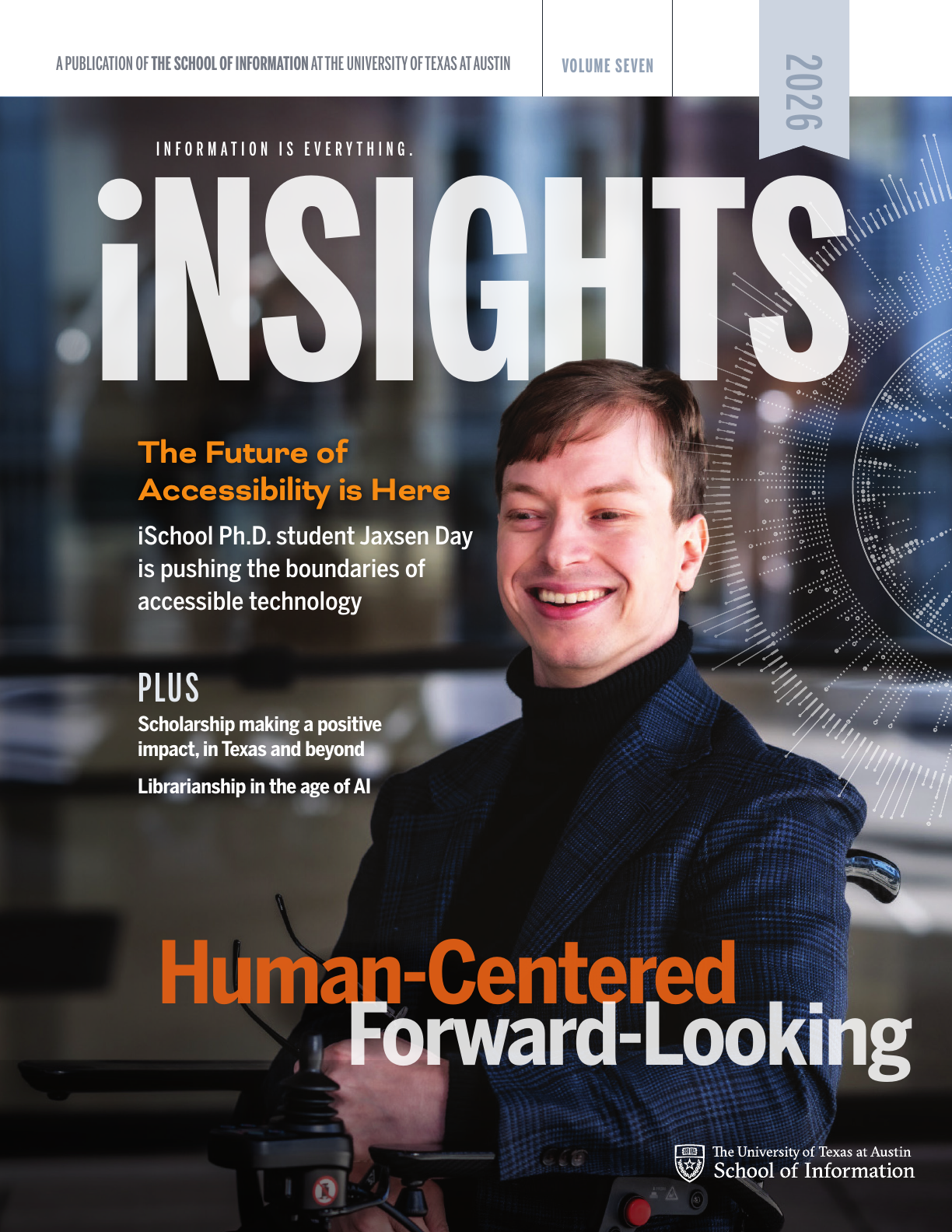
iNSIGHTS 2026 Cover
Information is everything.
A publication of
The School of Information
at The University of Texas at Austin
Volume Seven
iNSIGHTS 2026
The Future of
Accessibility is Here
Human-Centered
Forward-Looking
iSchool Ph.D. student Jaxsen Day is pushing the boundaries of accessible technology
PLUS
Scholarship making a positive impact, in Texas and beyond
Librarianship in the age of AI
Image Descriptions
- Cover photo of iSchool Ph.D. student Jaxsen Day seated in a wheelchair, wearing a black turtleneck and blue checked sport coat, smiling in a lab-like workspace.
From the Dean and Stay Connected
FROM THE DEAN
A PIVOTAL YEAR AT THE iSCHOOL
KEN FLEISCHMANN
Interim Dean | Chair Designate
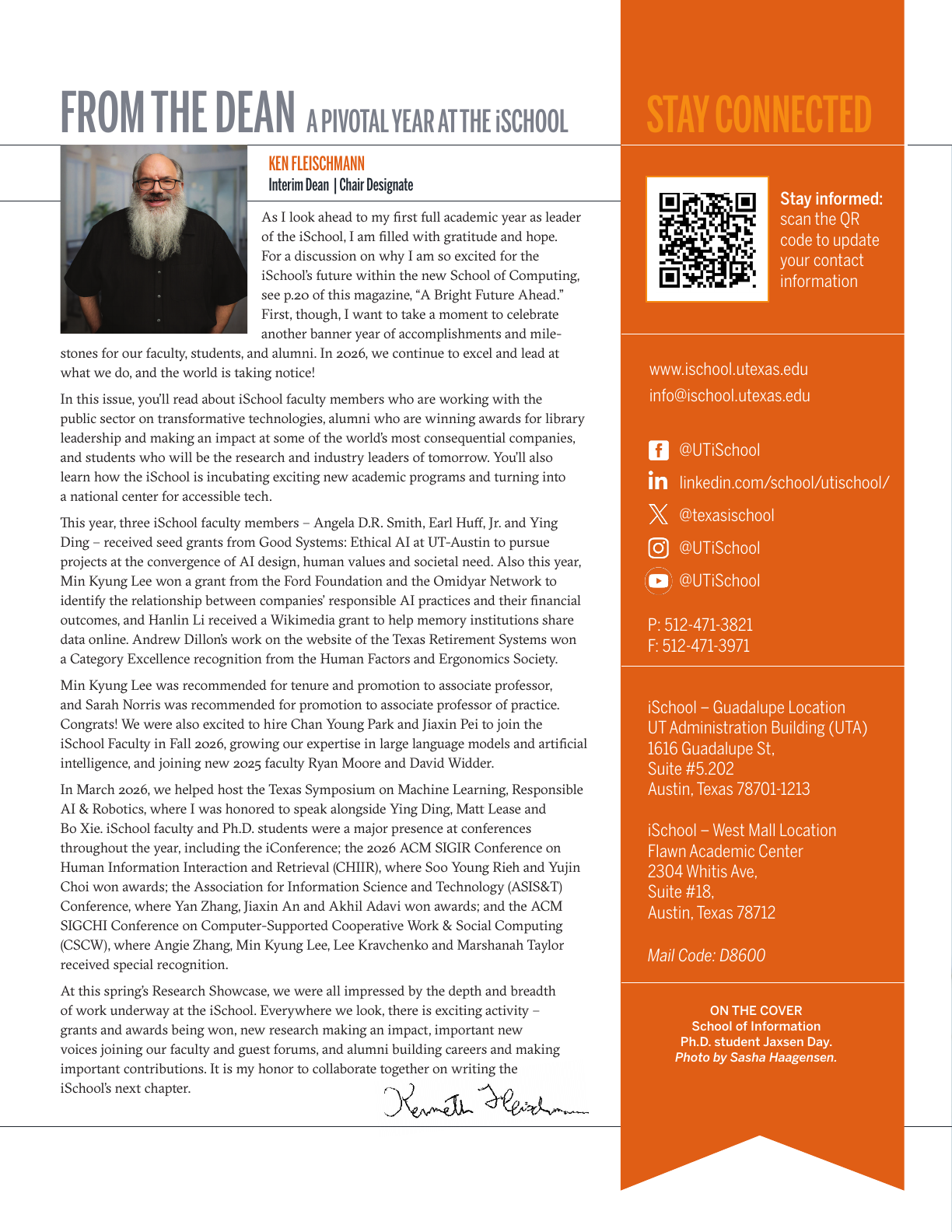
As I look ahead to my first full academic year as leader of the iSchool, I am filled with gratitude and hope. For a discussion on why I am so excited for the iSchool’s future within the new School of Computing, see p.20 of this magazine, “A Bright Future Ahead.” First, though, I want to take a moment to celebrate another banner year of accomplishments and milestones for our faculty, students, and alumni. In 2026, we continue to excel and lead at what we do, and the world is taking notice!
In this issue, you’ll read about iSchool faculty members who are working with the public sector on transformative technologies, alumni who are winning awards for library leadership and making an impact at some of the world’s most consequential companies, and students who will be the research and industry leaders of tomorrow. You’ll also learn how the iSchool is incubating exciting new academic programs and turning into a national center for accessible tech.
This year, three iSchool faculty members – Angela D.R. Smith, Earl Huff, Jr. and Ying Ding – received seed grants from Good Systems: Ethical AI at UT-Austin to pursue projects at the convergence of AI design, human values and societal need. Also this year, Min Kyung Lee won a grant from the Ford Foundation and the Omidyar Network to identify the relationship between companies’ responsible AI practices and their financial outcomes, and Hanlin Li received a Wikimedia grant to help memory institutions share data online. Andrew Dillon’s work on the website of the Texas Retirement Systems won a Category Excellence recognition from the Human Factors and Ergonomics Society.
Min Kyung Lee was recommended for tenure and promotion to associate professor, and Sarah Norris was recommended for promotion to associate professor of practice. Congrats! We were also excited to hire Chan Young Park and Jiaxin Pei to join the iSchool Faculty in Fall 2026, growing our expertise in large language models and artificial intelligence, and joining new 2025 faculty Ryan Moore and David Widder.
In March 2026, we helped host the Texas Symposium on Machine Learning, Responsible AI & Robotics, where I was honored to speak alongside Ying Ding, Matt Lease and Bo Xie. iSchool faculty and Ph.D. students were a major presence at conferences throughout the year, including the iConference; the 2026 ACM SIGIR Conference on Human Information Interaction and Retrieval (CHIIR), where Soo Young Rieh and Yujin Choi won awards; the Association for Information Science and Technology (ASIS&T) Conference, where Yan Zhang, Jiaxin An and Akhil Adavi won awards; and the ACM SIGCHI Conference on Computer-Supported Cooperative Work & Social Computing (CSCW), where Angie Zhang, Min Kyung Lee, Lee Kravchenko and Marshanah Taylor received special recognition.
At this spring’s Research Showcase, we were all impressed by the depth and breadth of work underway at the iSchool. Everywhere we look, there is exciting activity – grants and awards being won, new research making an impact, important new voices joining our faculty and guest forums, and alumni building careers and making important contributions. It is my honor to collaborate together on writing the iSchool’s next chapter.
ON THE COVER
School of Information
Ph.D. student Jaxsen Day.
Photo by Sasha Haagensen.
© The University of Texas at Austin 2024
Image Descriptions
- Headshot of Ken Fleischmann, a white man with a white beard and glasses, smiling in a black jacket against a neutral background.
- Ken Fleischmann's handwritten signature.
- Small cover photo of Jaxsen Day seated in a wheelchair, wearing a blue checked sport coat and smiling.
STAY CONNECTED
www.ischool.utexas.edu info@ischool.utexas.edu
P: 512-471-3821 F: 512-471-3971
iSchool – Guadalupe Location UT Administration Building (UTA) 1616 Guadalupe St, Suite #5.202 Austin, Texas 78701-1213
iSchool – West Mall Location Flawn Academic Center 2304 Whitis Ave, Suite #18, Austin, Texas 78712
Mail Code: D8600
@UTiSchool
linkedin.com/school/utischool/
@texasischool
@UTiSchool
@UTiSchool
Stay informed:
scan the QR code to update your contact information
Image Descriptions
- QR code for updating contact information with the School of Information.
Contents
© The University of Texas at Austin 2024
CONTENTS
2026
EDITORIAL TEAM:
ALEX GUTERBOCK, DEVELOPMENT SPECIALIST • MICHAEL AGRESTA, WRITER • SHANNON HICKSON, DIRECTOR OF
DEVELOPMENT & ALUMNI RELATIONS
DESIGN & ART DIRECTION:
SOUTHERN COMBUSTION CREATIVE/ ANNE-CHARLOTTE PATTERSON
PHOTOGRAPHY:
SASHA HAAGENSEN
Human-Centered
Forward-Looking
Using tech & expertise to
serve the public interest | p. 4
iSchool Alumni Garner
Librarian Awards
State and national honors bestowed on alumni | p. 10
2 Program Highlights
Texas Cybersecurity Clinic & iSchool Research Institute for StoryArc Exploration
12 The Future of Accessibility is Here!
iSchoolers pioneer inclusive technologies
17 Student Capstone Projects 18 iSchool Alumni
Finding success at IBM & Amazon
20 A Bright Future Ahead
What’s next for the iSchool
22 Humans in the Loop
A new book by Professor David Lankes explores librarianship in the age of AI
24 Collaborating for Impact
School of Information Research Partners
Image Descriptions
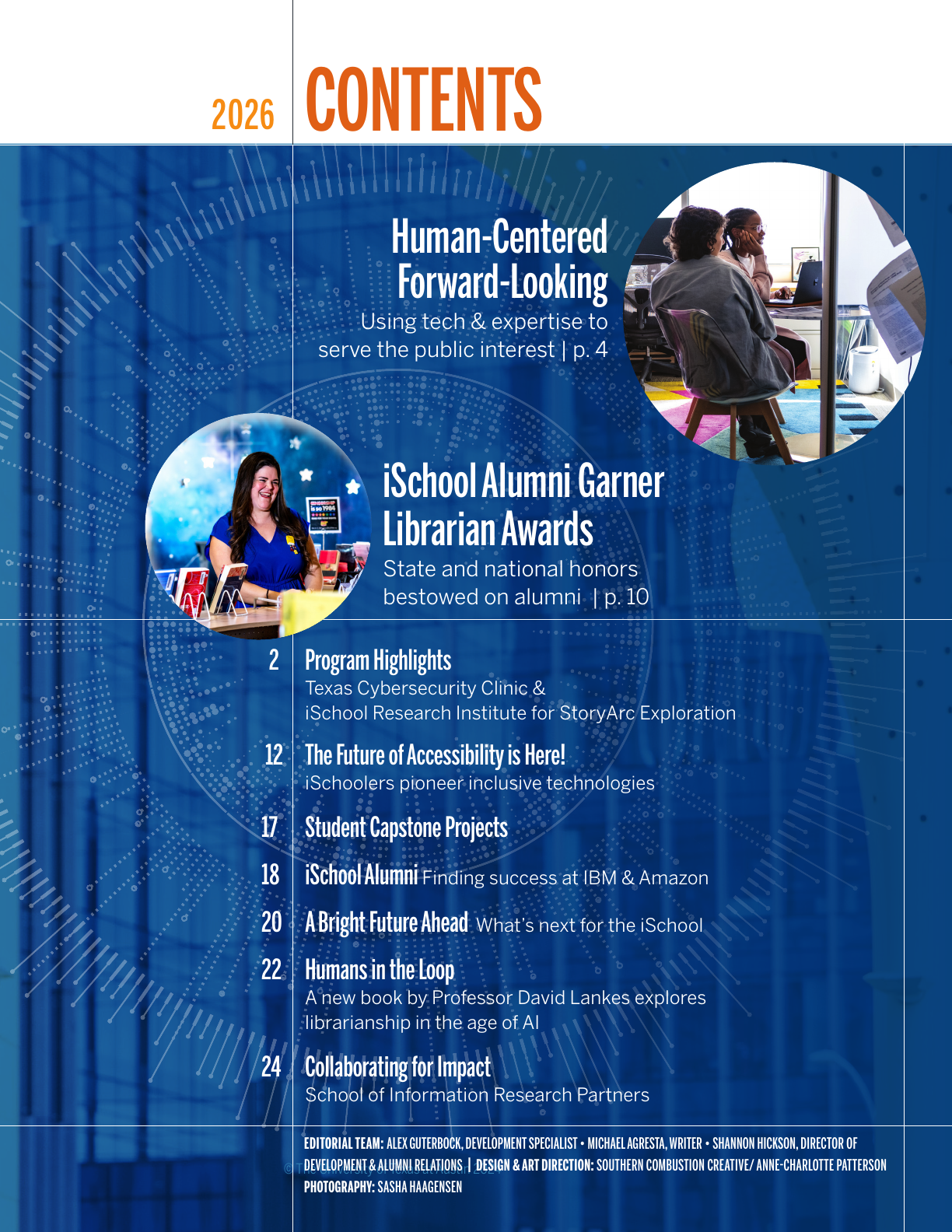
- Contents-page image of a woman in a royal blue shirt standing in a library display area with books and colorful displays behind her.
- Contents-page image of two people seated at a computer workstation in a bright office.
In Focus: Texas Cybersecurity Clinic
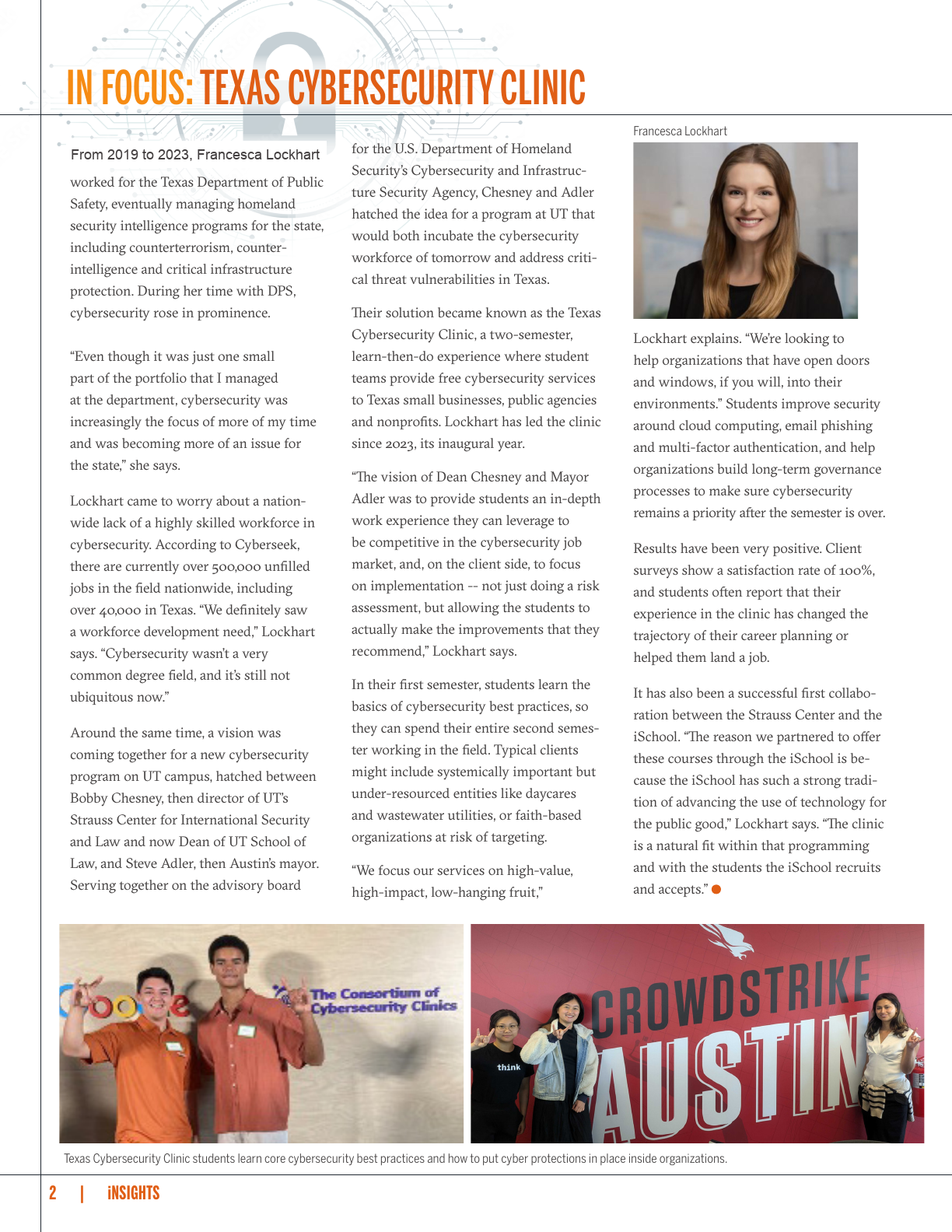
Texas Cybersecurity Clinic students learn core cybersecurity best practices and how to put cyber protections in place inside organizations.
Francesca Lockhart
From 2019 to 2023, Francesca Lockhart worked for the Texas Department of Public Safety, eventually managing homeland security intelligence programs for the state, including counterterrorism, counterintelligence and critical infrastructure protection. During her time with DPS, cybersecurity rose in prominence.
“Even though it was just one small part of the portfolio that I managed at the department, cybersecurity was increasingly the focus of more of my time and was becoming more of an issue for the state,” she says.
Lockhart came to worry about a nationwide lack of a highly skilled workforce in cybersecurity. According to Cyberseek, there are currently over 500,000 unfilled jobs in the field nationwide, including over 40,000 in Texas. “We definitely saw a workforce development need,” Lockhart says. “Cybersecurity wasn’t a very common degree field, and it’s still not ubiquitous now.”
Around the same time, a vision was coming together for a new cybersecurity program on UT campus, hatched between Bobby Chesney, then director of UT’s Strauss Center for International Security and Law and now Dean of UT School of Law, and Steve Adler, then Austin’s mayor. Serving together on the advisory board
for the U.S. Department of Homeland Security’s Cybersecurity and Infrastructure Security Agency, Chesney and Adler hatched the idea for a program at UT that would both incubate the cybersecurity workforce of tomorrow and address critical threat vulnerabilities in Texas.
Their solution became known as the Texas Cybersecurity Clinic, a two-semester, learn-then-do experience where student teams provide free cybersecurity services to Texas small businesses, public agencies and nonprofits. Lockhart has led the clinic since 2023, its inaugural year.
“The vision of Dean Chesney and Mayor Adler was to provide students an in-depth work experience they can leverage to be competitive in the cybersecurity job market, and, on the client side, to focus on implementation -- not just doing a risk assessment, but allowing the students to actually make the improvements that they recommend,” Lockhart says.
In their first semester, students learn the basics of cybersecurity best practices, so they can spend their entire second semester working in the field. Typical clients might include systemically important but under-resourced entities like daycares and wastewater utilities, or faith-based organizations at risk of targeting.
“We focus our services on high-value, high-impact, low-hanging fruit,”
Lockhart explains. “We’re looking to help organizations that have open doors and windows, if you will, into their environments.” Students improve security around cloud computing, email phishing and multi-factor authentication, and help organizations build long-term governance processes to make sure cybersecurity remains a priority after the semester is over.
Results have been very positive. Client surveys show a satisfaction rate of 100%, and students often report that their experience in the clinic has changed the trajectory of their career planning or helped them land a job.
It has also been a successful first collaboration between the Strauss Center and the iSchool. “The reason we partnered to offer these courses through the iSchool is because the iSchool has such a strong tradition of advancing the use of technology for the public good,” Lockhart says. “The clinic is a natural fit within that programming and with the students the iSchool recruits and accepts.”
IN FOCUS:
TEXAS CYBERSECURITY CLINIC
Image Descriptions
- Portrait of Francesca Lockhart, a white woman with long blonde hair, smiling in a black jacket.
- Two students in burnt-orange shirts posing with hook 'em hand signs at a Consortium of Cybersecurity Clinics event.
- Three students standing in front of a red CrowdStrike Austin wall display.
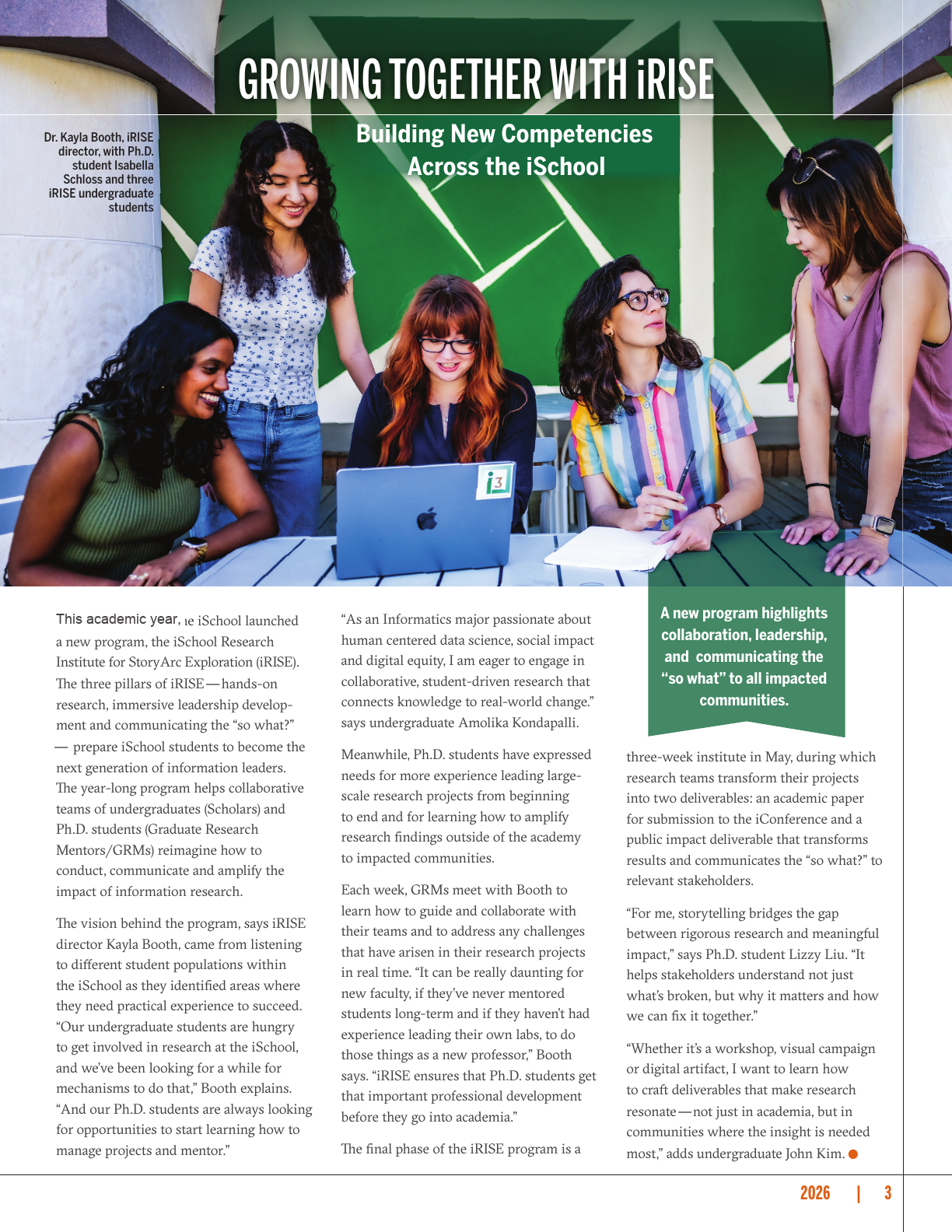
Growing Together with iRISE
This academic year, the iSchool launched a new program, the iSchool Research Institute for StoryArc Exploration (iRISE). The three pillars of iRISE — hands-on research, immersive leadership development and communicating the “so what?” — prepare iSchool students to become the next generation of information leaders. The year-long program helps collaborative teams of undergraduates (Scholars) and Ph.D. students (Graduate Research Mentors/GRMs) reimagine how to conduct, communicate and amplify the impact of information research.
The vision behind the program, says iRISE director Kayla Booth, came from listening to different student populations within the iSchool as they identified areas where they need practical experience to succeed. “Our undergraduate students are hungry to get involved in research at the iSchool, and we’ve been looking for a while for mechanisms to do that,” Booth explains. “And our Ph.D. students are always looking for opportunities to start learning how to manage projects and mentor.”
“As an Informatics major passionate about human centered data science, social impact and digital equity, I am eager to engage in collaborative, student-driven research that connects knowledge to real-world change.” says undergraduate Amolika Kondapalli.
Meanwhile, Ph.D. students have expressed needs for more experience leading large-scale research projects from beginning to end and for learning how to amplify research findings outside of the academy to impacted communities.
Each week, GRMs meet with Booth to learn how to guide and collaborate with their teams and to address any challenges that have arisen in their research projects in real time. “It can be really daunting for new faculty, if they’ve never mentored students long-term and if they haven’t had experience leading their own labs, to do those things as a new professor,” Booth says. “iRISE ensures that Ph.D. students get that important professional development before they go into academia.”
The final phase of the iRISE program is a
three-week institute in May, during which research teams transform their projects into two deliverables: an academic paper for submission to the iConference and a public impact deliverable that transforms results and communicates the “so what?” to relevant stakeholders.
“For me, storytelling bridges the gap between rigorous research and meaningful impact,” says Ph.D. student Lizzy Liu. “It helps stakeholders understand not just what’s broken, but why it matters and how we can fix it together.”
“Whether it’s a workshop, visual campaign or digital artifact, I want to learn how to craft deliverables that make research resonate — not just in academia, but in communities where the insight is needed most,” adds undergraduate John Kim.
A new program highlights
collaboration, leadership,
and communicating the
“so what” to all impacted
communities.
Dr. Kayla Booth, iRISE
director, with Ph.D.
student Isabella
Schloss and three
iRISE undergraduate
students
GROWING TOGETHER WITH iRISE
Building New Competencies Across the iSchool
Image Descriptions
- Five iRISE students gathered outdoors around a laptop and notebook at a table, talking and smiling.
Human-Centered Forward-Looking
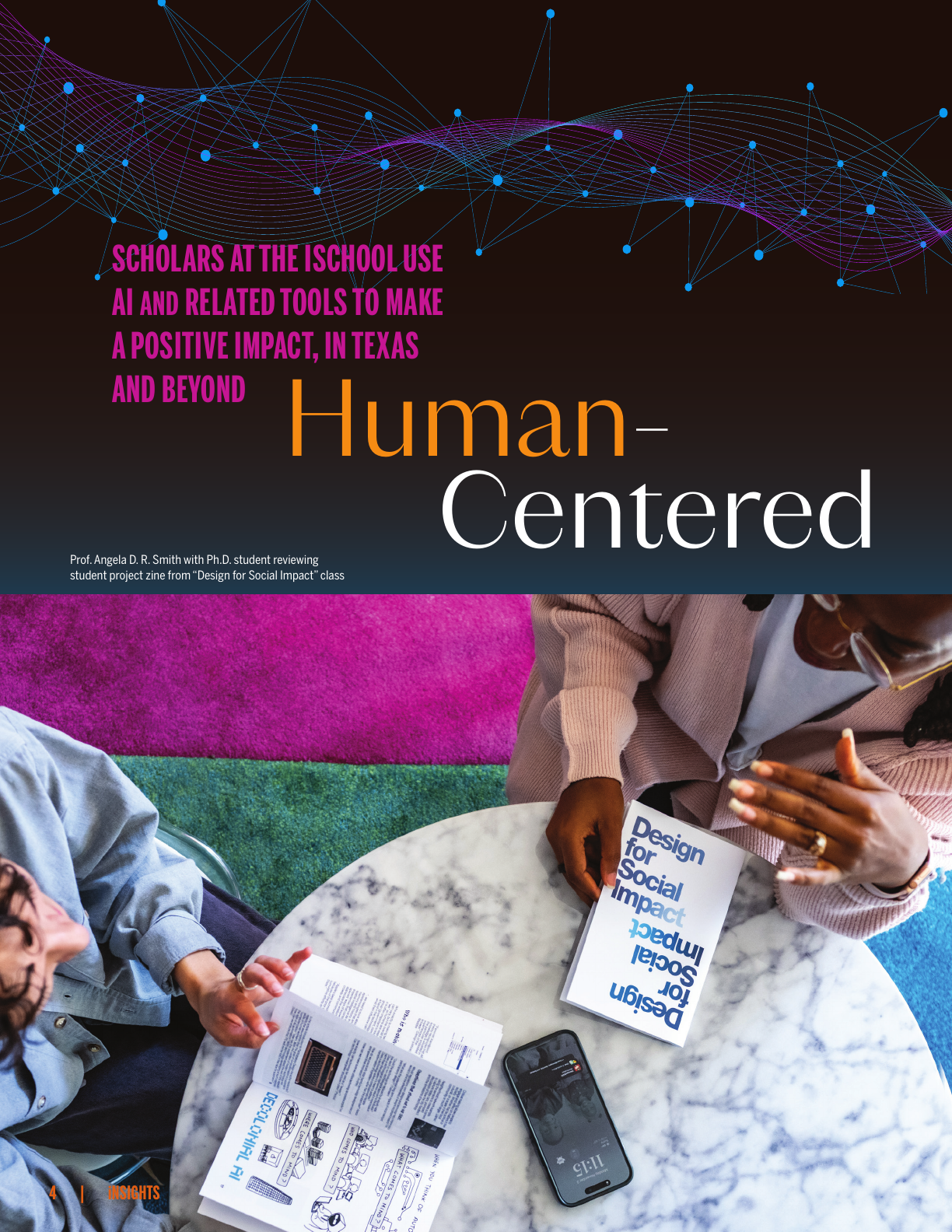
Human-Centered Forward-Looking: scholars at the iSchool use AI and related tools to make a positive impact, in Texas and beyond.
Prof. Angela D. R. Smith with Ph.D. student reviewing student project zine from “Design for Social Impact” class
Image Descriptions
- Overhead photo of two people reviewing printed project zines, including a Design for Social Impact zine, at a round marble table.
Human-Centered Forward-Looking, continued
Ken Fleischmann, chair designate and interim dean of the iSchool, approaches his leadership vision in the same way he does his own research, which focuses on designing ethical artificial intelligence systems that benefit society. In both spheres, the aim is to help people thrive by finding ways for them to harness and benefit from advances in information technology.
“We’re committed to both research and education where technology serves the public interest,” Fleischmann says. “We aspire to make a difference in the world.” In line with that mission, Fleischmann gave a keynote address to statewide county leaders last year at the Texas Conference of Urban Counties.
The iSchool’s human-centered, forward-looking outlook goes back to our founding mission, preparing librarians to serve local communities across Texas and the U.S. It extends to new horizons, as we train the next generation of AI-empowered designers and information scientists. Often, it means making an impact on the ground – including at the municipal and county level here in Texas.
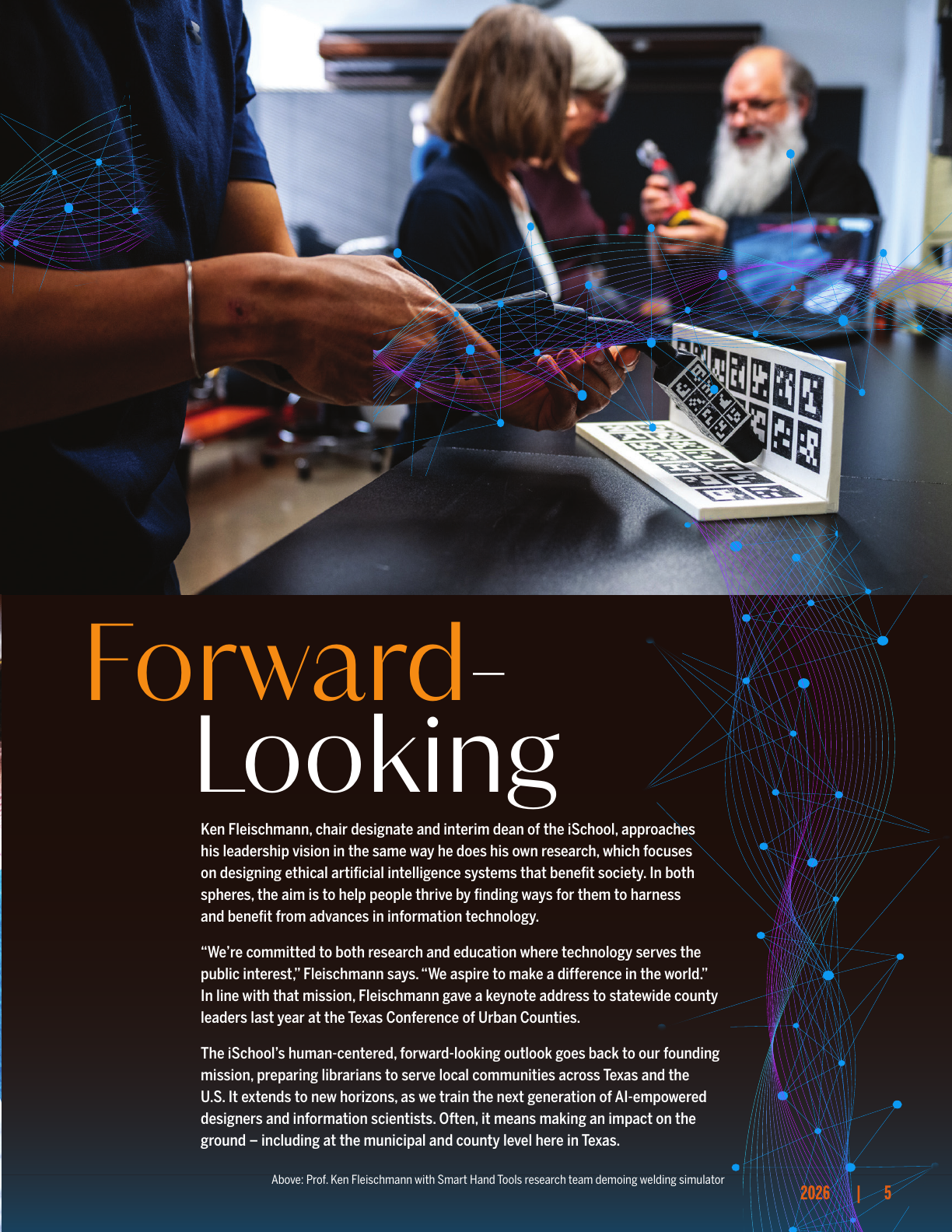
Above: Prof. Ken Fleischmann with Smart Hand Tools research team demoing welding simulator
Image Descriptions
- Close-up of a participant using a small handheld tool beside a board of printed fiducial markers during an accessibility technology demonstration.
- A participant cutting paper with scissors during a hands-on design or prototyping activity.
Human-Centered Forward-Looking, continued
BUILDING THE FUTURE OF
BLUE-COLLAR WORK
Fleischmann is the founding chair of Good Systems, Ethical AI at UT Austin, where one collaboration with colleagues in the Cockrell School of Engineering and the LBJ School of Public Affairs focuses on addressing the risks and opportunities facing America’s blue-collar workforce in the age of AI. The goal is to build the next generation of smart hand tools to optimize safety, productivity and training quality. His team is partnering with Austin Community College, the City of Austin and the Texas AFL-CIO to develop smart hand tools for welders and other skilled trade workers – with participatory input from workers and trainees. At the iSchool, Ph.D. students Chelsea McCullough, Tina Lassiter, Jessica Needle and Haley Triem have led the participatory design process.
Fleischmann believes AI can help make welding safer. “We’re hoping to be able to give workers feedback that could help reduce the number of repetitive-stress injuries and workplace accidents, and also improve workers’ overall quality of life,” he says. “In many ways, it’s similar to the idea of a digital assistant, which we often think about in the context of knowledge work, but a digital assistant for skilled-trade workers.”
Their prototype is a sensor box attached to a welding torch so that the worker controls the tool itself, the AI and the data collected. This vision emerged from surveys, interviews and participatory design workshops with workers, managers, apprentices and union leaders, as well as with students and instructors in the ACC welding program. Fleischmann emphasizes that the purpose of the design process is not to replace human welders or to increase employer surveillance, but to empower workers with feedback and collaborative learning.
“This is a perfect opportunity for us to combine the technical considerations from the engineering side with some larger economic policy considerations,” Fleischmann says. “It’s a truly convergent project.”
Fleischmann and his collaborators envision a future where workforce training embraces AI tools and possibilities, asking how technological advances can be leveraged to keep workers safe and help them thrive.
“For knowledge work, I think we’ve accepted the notion that humans-plus-AI is better than humans alone or AI alone,” he says. “We believe the same is true for skilled-trade work.”
TOWARDS A PEOPLE-POWERED AI
There’s a prevalent fear that the use of AI systems, especially in government, will lead to less input for citizens, as society puts blind trust in algorithms to solve problems. iSchool professor Min Kyung Lee has a diametrically opposite vision. Her research explores ways of empowering AI users to define algorithmic goals and metrics, and to see their own preferences reflected unambiguously in the outcomes. This emerging field of study is known as “participatory AI.”
“Participatory AI involves either the public or relevant stakeholders in both designing AI systems and in governing them after deployment,” Lee explains. “Most of my work takes place either in workplaces or in domains where we work with the public on decisions that impact them.”
An inflection point in Lee’s research was her work six years ago with the Pittsburgh charity 412 Food Rescue, which matches food donations with local food-distributing non-profits. She was tasked
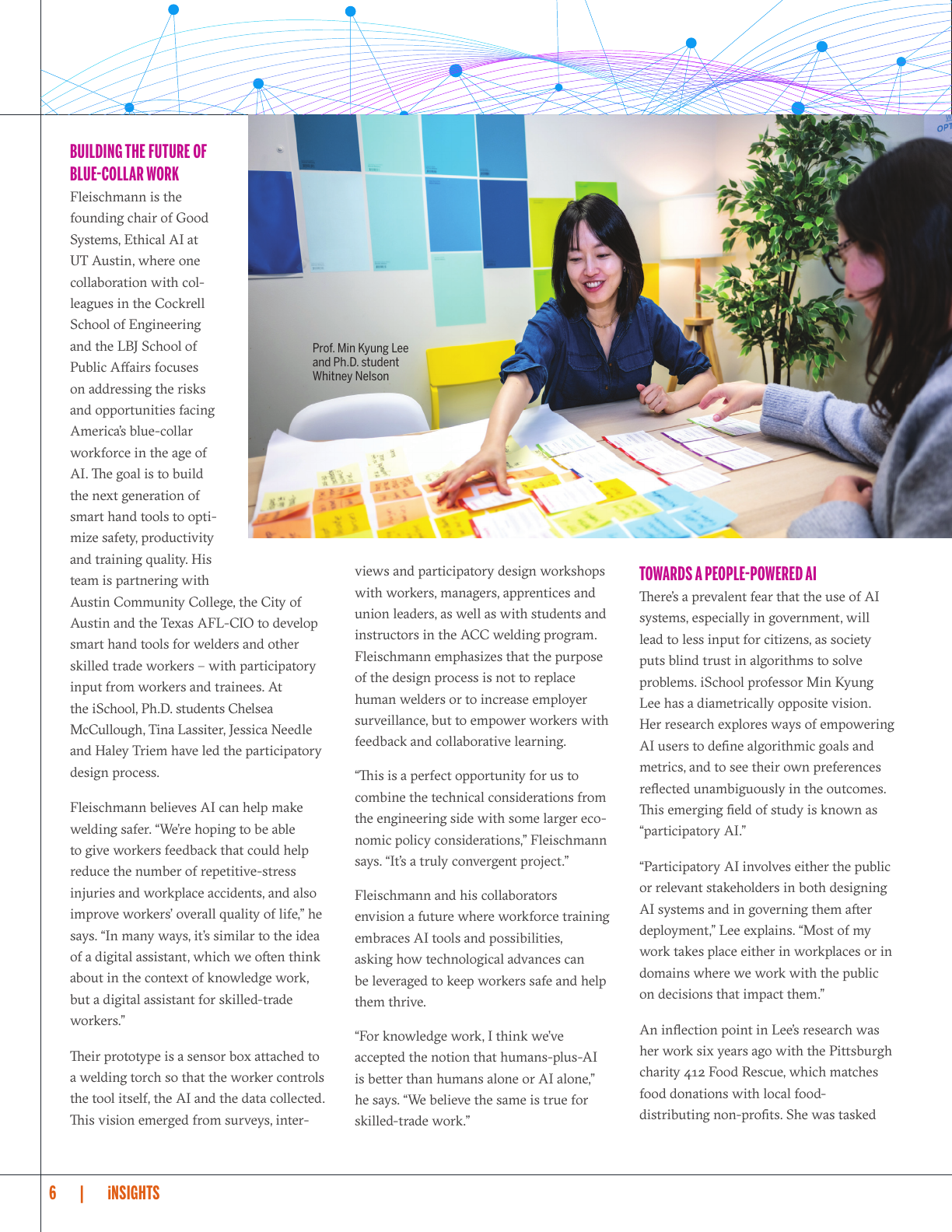
Prof. Min Kyung Lee
and Ph.D. student
Whitney Nelson
Image Descriptions
- Two people collaborating at a table covered with colorful sticky notes and planning cards in a design workspace.
Human-Centered Forward-Looking, continued
with building an algorithm to match food donations with recipient organizations.
“I initially thought, ‘Oh, I’m going to find a way to optimize this matching decision considering driving distance and other metrics that people care about,’” Lee says. “But I quickly realized that there are multiple ways to optimize, and not everyone agreed on the metrics to optimize for.”
As she talked to donors, recipient organizations and volunteers, Lee noticed that different stakeholders cared about different factors, like physical proximity, poverty level of people served, or spreading out donations among different organizations.
Even more challenging was defining how exactly the algorithm should interpret stated preferences. “Translating qualitative feedback into an AI system, there is ambiguity,” she explains. “Often it is the developers, the people making the AI system, doing that translating. Bias can play a role.”
For example, stakeholders might say they prefer to optimize for fairness, but fairness can mean many things, including both equality of opportunity and equality of outcome. To navigate this challenge, Lee and her team created a questionnaire in which stakeholders were repeatedly asked to choose between pairs of hypothetical recipient organizations. Lee then trained her AI system on these decisions. “We wanted people to be able to speak in the AI’s language, in a way, so that developers wouldn’t have to translate for them,” Lee says.
While stakeholders are rarely unanimous on priorities, Lee’s participatory AI framework, WeBuildAI, helps them understand better where they disagree, creating a basis for compromise and organizational insight. Recently, Lee worked with an admissions team at a U.S. public university on a participatory AI project that involved analyzing historical admissions data across various candidate attributes.
“Seeing the historical patterns showed the admissions officers how they made their decisions,” Lee says. “We saw what people agreed on and where they disagreed – for example, who thinks that GRE is important, or who cares more about the statement of purpose. One of the biggest benefits of this participatory method is that stakeholders learn more about themselves.”
These days, Lee is taking on her most ambitious participatory AI project yet: a collaboration with the City of Austin Department of Transportation planning for urban air mobility – in common parlance, electric helicopter taxis. Where should such systems be allowed to fly and install helipads? Lee’s team is gathering stakeholder data for an AI model that will design routes optimized not only for geography, safety and economic impact, but also for accessibility and environmental concerns like noise.
“It’s important, because the way ground transportation was designed historically was biased in certain ways,” Lee says. “This is happening now, and we want to help inform decision-makers so they can consider different communities’ needs.”
AFTER THE FLOODS
For some iSchoolers, like Fleischmann and Lee, grappling with emerging twenty-first century challenges means working to put people first in the development of new technologies like AI. For others, like professor Sarah Norris and lecturer Rebecca Elder, it means preserving old-media technologies – books, photographs and other collector and heirloom items – in the face of new weather and climate risks.
In Norris’s “Disaster Planning and Response” course, students practice water salvage, fire salvage and mold remediation in hands-on exercises, including in community volunteer contexts. “Because disaster response and planning is becoming ever more critical in our world, given changes in our climate, we focus on it explicitly as a course in our master’s program,” she says. “We also try to get students involved, as possible, with current outreach and disaster response that inevitably comes up as the class is running.”
As Norris strives to connect students with volunteer opportunities, it helps that her colleague Elder, who teaches a course in “Preservation Management and Treatment Techniques for Bound Materials,” also runs a business in historical preservation and serves as coordinator National Heritage Responders, the American Institute for Conservation’s volunteer emergency team.
“She’s been a really thoughtful contributor to our disasters course,” Norris says of Elder. “We’ll have students who want to know more about the current response to, say, a hurricane, and we’re able to shift the course in real time to bring in that perspective.”
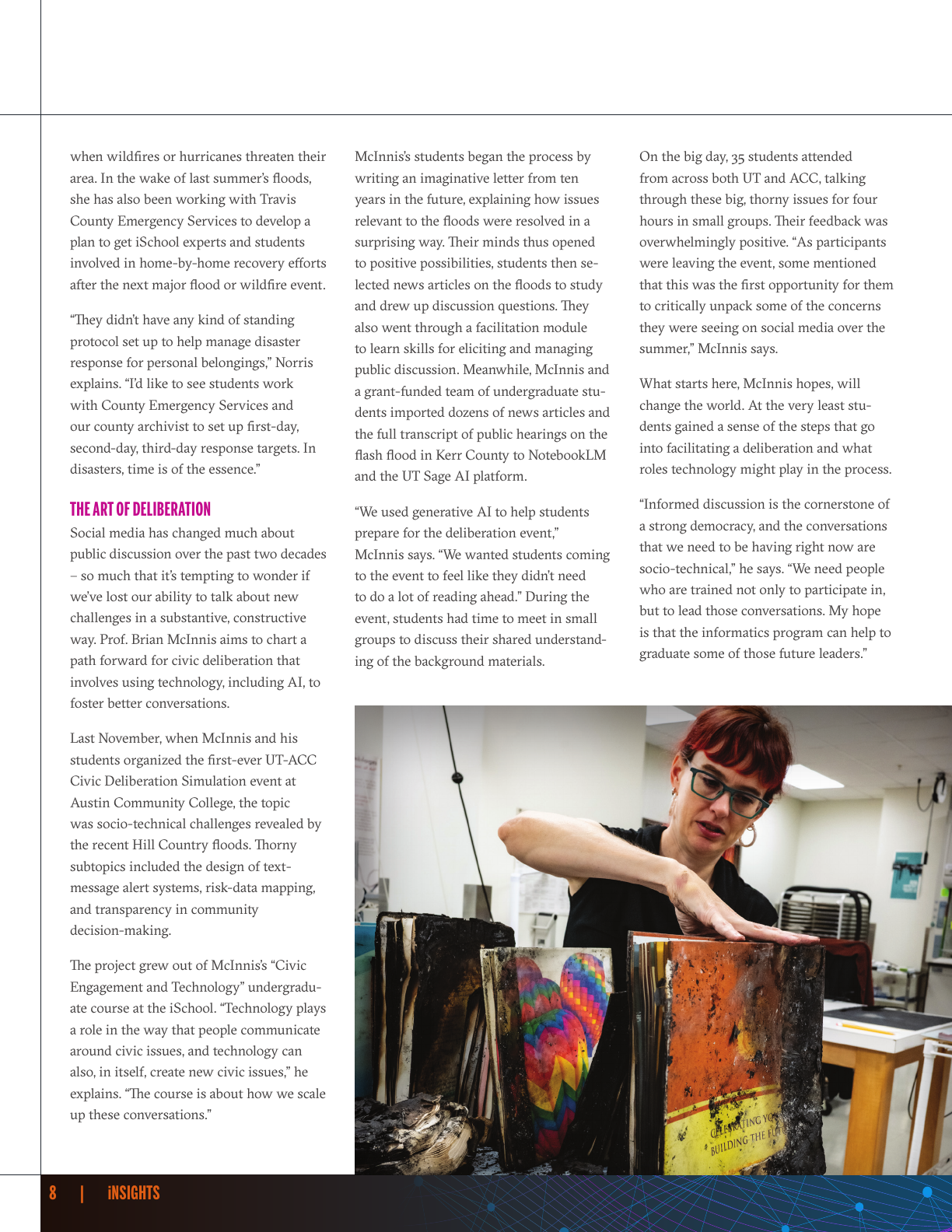
At the same time, Norris has launched a series of efforts aimed at educating the public on conservation issues and helping memory institutions better prepare for natural disasters. She maintains an iSchool disaster response webpage, recently updated in the wake of the deadly July 2025 Central Texas floods, that offers families quick tips on emergency salvage of papers and photos, as well as links to more specialized guides. She has also hosted preservation clinics on Zoom, fielding questions about how best to store family Civil War correspondence and how to preserve a child’s artwork in charcoal and pastels, for example.
Norris has an ambitious proposal in motion, still seeking funding, for helping cultural heritage organizations purchase and utilize modular storage units, which could make it easier for them to transport priceless collections out of harm’s way
Human-Centered Forward-Looking, continued
when wildfires or hurricanes threaten their area. In the wake of last summer’s floods, she has also been working with Travis County Emergency Services to develop a plan to get iSchool experts and students involved in home-by-home recovery efforts after the next major flood or wildfire event.
“They didn’t have any kind of standing protocol set up to help manage disaster response for personal belongings,” Norris explains. “I’d like to see students work with County Emergency Services and our county archivist to set up first-day, second-day, third-day response targets. In disasters, time is of the essence.”
THE ART OF DELIBERATION
Social media has changed much about public discussion over the past two decades – so much that it’s tempting to wonder if we’ve lost our ability to talk about new challenges in a substantive, constructive way. Prof. Brian McInnis aims to chart a path forward for civic deliberation that involves using technology, including AI, to foster better conversations.
Last November, when McInnis and his students organized the first-ever UT-ACC Civic Deliberation Simulation event at Austin Community College, the topic was socio-technical challenges revealed by the recent Hill Country floods. Thorny subtopics included the design of text-message alert systems, risk-data mapping, and transparency in community decision-making.
The project grew out of McInnis’s “Civic Engagement and Technology” undergraduate course at the iSchool. “Technology plays a role in the way that people communicate around civic issues, and technology can also, in itself, create new civic issues,” he explains. “The course is about how we scale up these conversations.”
McInnis’s students began the process by writing an imaginative letter from ten years in the future, explaining how issues relevant to the floods were resolved in a surprising way. Their minds thus opened to positive possibilities, students then selected news articles on the floods to study and drew up discussion questions. They also went through a facilitation module to learn skills for eliciting and managing public discussion. Meanwhile, McInnis and a grant-funded team of undergraduate students imported dozens of news articles and the full transcript of public hearings on the flash flood in Kerr County to NotebookLM and the UT Sage AI platform.
“We used generative AI to help students prepare for the deliberation event,” McInnis says. “We wanted students coming to the event to feel like they didn’t need to do a lot of reading ahead.” During the event, students had time to meet in small groups to discuss their shared understanding of the background materials.
On the big day, 35 students attended from across both UT and ACC, talking through these big, thorny issues for four hours in small groups. Their feedback was overwhelmingly positive. “As participants were leaving the event, some mentioned that this was the first opportunity for them to critically unpack some of the concerns they were seeing on social media over the summer,” McInnis says.
What starts here, McInnis hopes, will change the world. At the very least students gained a sense of the steps that go into facilitating a deliberation and what roles technology might play in the process.
“Informed discussion is the cornerstone of a strong democracy, and the conversations that we need to be having right now are socio-technical,” he says. “We need people who are trained not only to participate in, but to lead those conversations. My hope is that the informatics program can help to graduate some of those future leaders.”
Image Descriptions
- A preservation worker with short red hair and glasses examining fire-damaged books in a conservation workspace.
Human-Centered Forward-Looking, continued
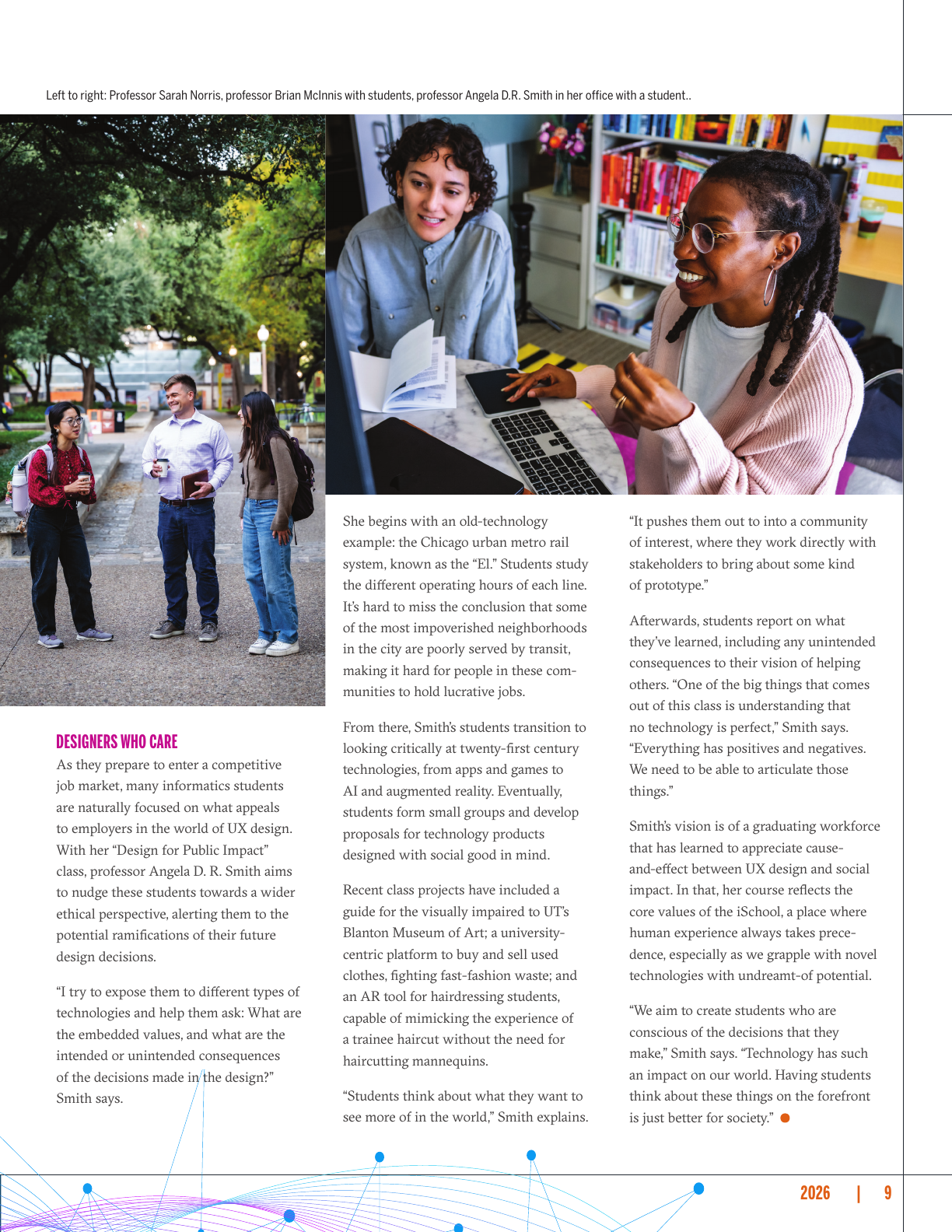
Left to right: Professor Sarah Norris, professor Brian McInnis with students, professor Angela D.R. Smith in her office with a student..
DESIGNERS WHO CARE
As they prepare to enter a competitive job market, many informatics students are naturally focused on what appeals to employers in the world of UX design. With her “Design for Public Impact” class, professor Angela D. R. Smith aims to nudge these students towards a wider ethical perspective, alerting them to the potential ramifications of their future design decisions.
“I try to expose them to different types of technologies and help them ask: What are the embedded values, and what are the intended or unintended consequences of the decisions made in the design?” Smith says.
She begins with an old-technology example: the Chicago urban metro rail system, known as the “El.” Students study the different operating hours of each line. It’s hard to miss the conclusion that some of the most impoverished neighborhoods in the city are poorly served by transit, making it hard for people in these communities to hold lucrative jobs.
From there, Smith’s students transition to looking critically at twenty-first century technologies, from apps and games to AI and augmented reality. Eventually, students form small groups and develop proposals for technology products designed with social good in mind.
Recent class projects have included a guide for the visually impaired to UT’s Blanton Museum of Art; a university-centric platform to buy and sell used clothes, fighting fast-fashion waste; and an AR tool for hairdressing students, capable of mimicking the experience of a trainee haircut without the need for haircutting mannequins.
“Students think about what they want to see more of in the world,” Smith explains.
“It pushes them out to into a community of interest, where they work directly with stakeholders to bring about some kind of prototype.”
Afterwards, students report on what they’ve learned, including any unintended consequences to their vision of helping others. “One of the big things that comes out of this class is understanding that no technology is perfect,” Smith says. “Everything has positives and negatives. We need to be able to articulate those things.”
Smith’s vision is of a graduating workforce that has learned to appreciate cause-and-effect between UX design and social impact. In that, her course reflects the core values of the iSchool, a place where human experience always takes precedence, especially as we grapple with novel technologies with undreamt-of potential.
“We aim to create students who are conscious of the decisions that they make,” Smith says. “Technology has such an impact on our world. Having students think about these things on the forefront is just better for society.”
Image Descriptions
- Three people talking outside on a tree-lined campus walkway.
- Two people collaborating at a laptop in an office or study room with bookshelves behind them.
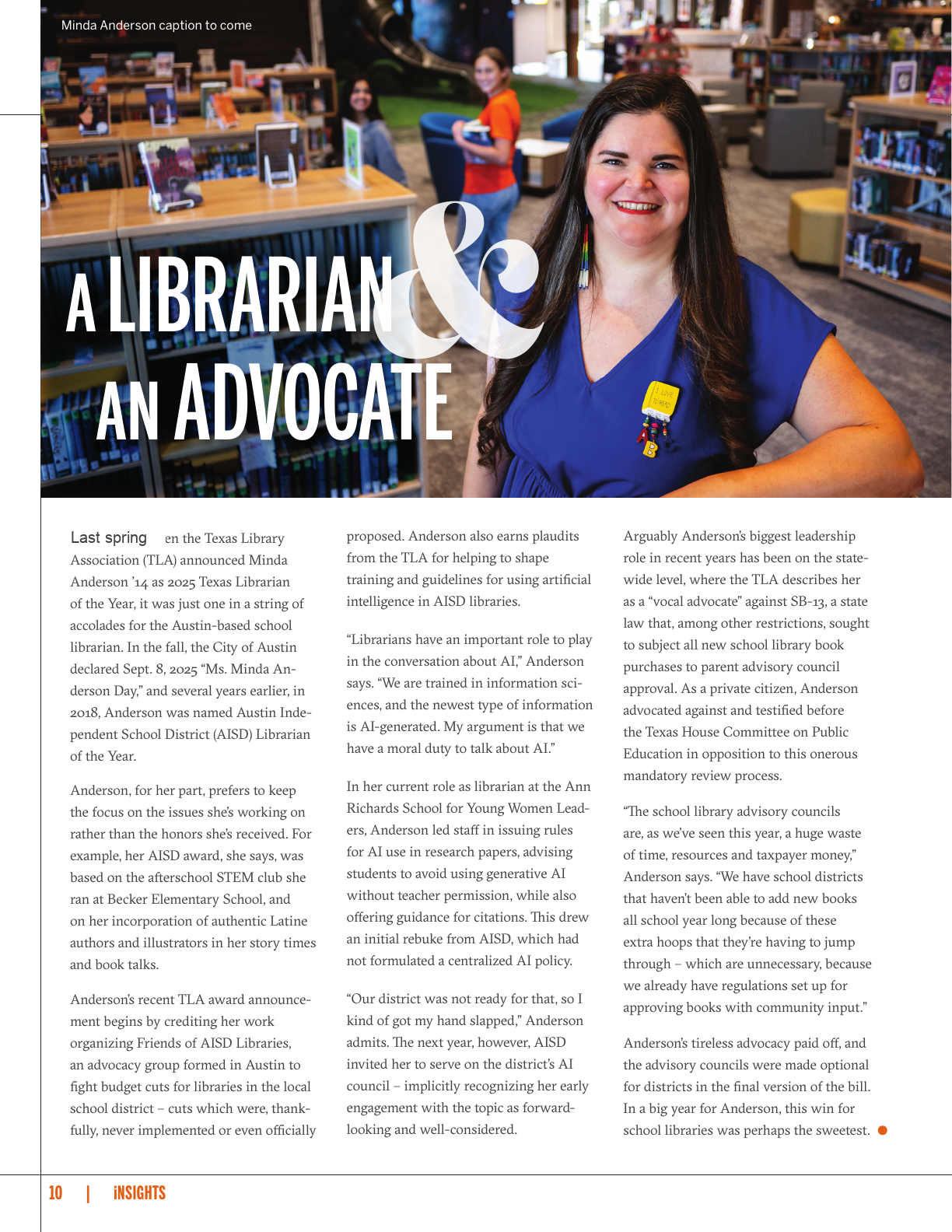
A Librarian and an Advocate
Last spring, when the Texas Library Association (TLA) announced Minda Anderson ’14 as 2025 Texas Librarian of the Year, it was just one in a string of accolades for the Austin-based school librarian. In the fall, the City of Austin declared Sept. 8, 2025 “Ms. Minda Anderson Day,” and several years earlier, in 2018, Anderson was named Austin Independent School District (AISD) Librarian of the Year.
Anderson, for her part, prefers to keep the focus on the issues she’s working on rather than the honors she’s received. For example, her AISD award, she says, was based on the afterschool STEM club she ran at Becker Elementary School, and on her incorporation of authentic Latine authors and illustrators in her story times and book talks.
Anderson’s recent TLA award announcement begins by crediting her work organizing Friends of AISD Libraries, an advocacy group formed in Austin to fight budget cuts for libraries in the local school district – cuts which were, thankfully, never implemented or even officially
proposed. Anderson also earns plaudits from the TLA for helping to shape training and guidelines for using artificial intelligence in AISD libraries.
“Librarians have an important role to play in the conversation about AI,” Anderson says. “We are trained in information sciences, and the newest type of information is AI-generated. My argument is that we have a moral duty to talk about AI.”
In her current role as librarian at the Ann Richards School for Young Women Leaders, Anderson led staff in issuing rules for AI use in research papers, advising students to avoid using generative AI without teacher permission, while also offering guidance for citations. This drew an initial rebuke from AISD, which had not formulated a centralized AI policy.
“Our district was not ready for that, so I kind of got my hand slapped,” Anderson admits. The next year, however, AISD invited her to serve on the district’s AI council – implicitly recognizing her early engagement with the topic as forward-looking and well-considered.
Arguably Anderson’s biggest leadership role in recent years has been on the state-wide level, where the TLA describes her as a “vocal advocate” against SB-13, a state law that, among other restrictions, sought to subject all new school library book purchases to parent advisory council approval. As a private citizen, Anderson advocated against and testified before the Texas House Committee on Public Education in opposition to this onerous mandatory review process.
“The school library advisory councils are, as we’ve seen this year, a huge waste of time, resources and taxpayer money,” Anderson says. “We have school districts that haven’t been able to add new books all school year long because of these extra hoops that they’re having to jump through – which are unnecessary, because we already have regulations set up for approving books with community input.”
Anderson’s tireless advocacy paid off, and the advisory councils were made optional for districts in the final version of the bill. In a big year for Anderson, this win for school libraries was perhaps the sweetest.
Minda Anderson caption to come
Image Descriptions
- A librarian in a royal blue blouse standing in a library aisle with bookshelves and patrons in the background.
A Force for International Libraries
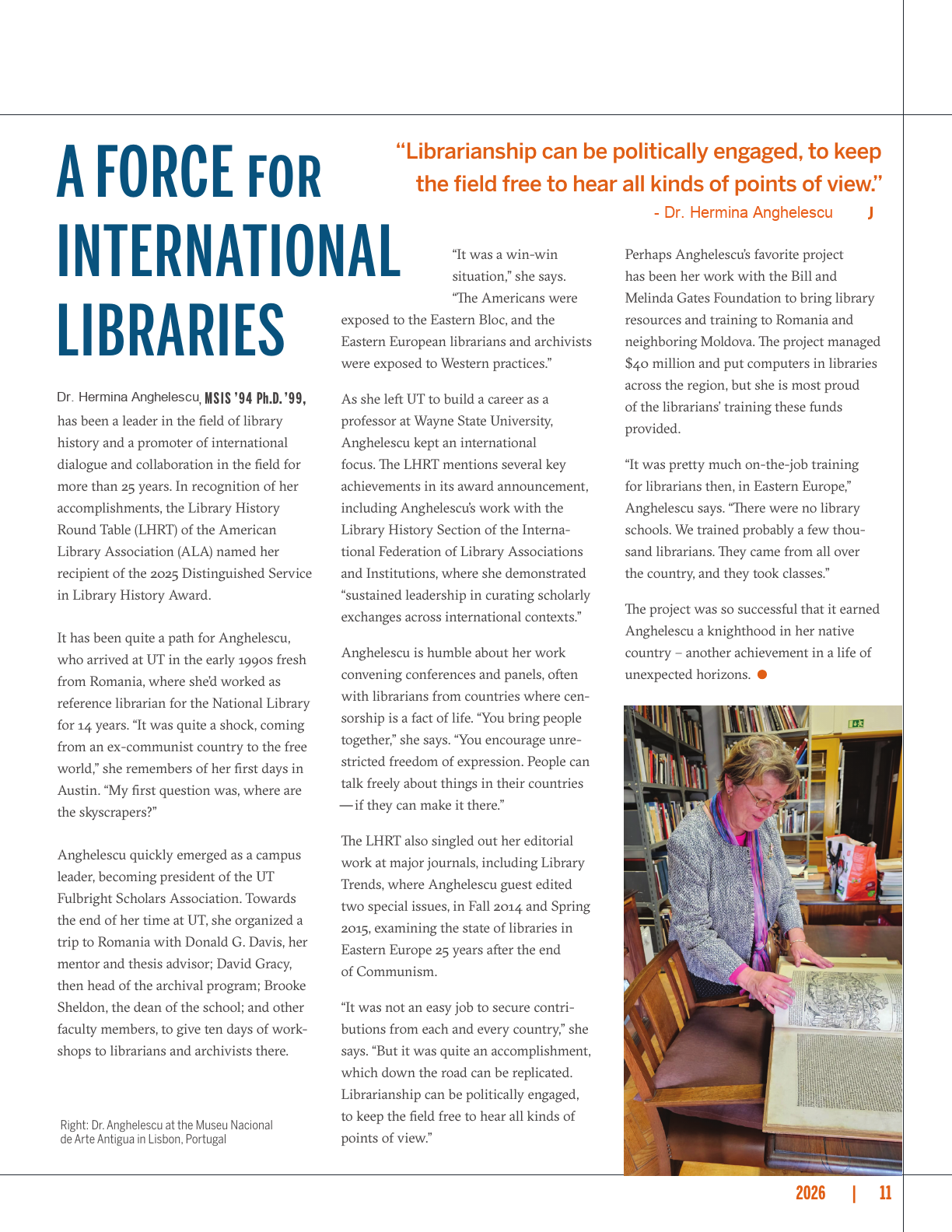
Dr. Hermina Anghelescu, MSIS ’94 Ph.D. ’99, has been a leader in the field of library history and a promoter of international dialogue and collaboration in the field for more than 25 years. In recognition of her accomplishments, the Library History Round Table (LHRT) of the American Library Association (ALA) named her recipient of the 2025 Distinguished Service in Library History Award.
It has been quite a path for Anghelescu, who arrived at UT in the early 1990s fresh from Romania, where she’d worked as reference librarian for the National Library for 14 years. “It was quite a shock, coming from an ex-communist country to the free world,” she remembers of her first days in Austin. “My first question was, where are the skyscrapers?”
Anghelescu quickly emerged as a campus leader, becoming president of the UT Fulbright Scholars Association. Towards the end of her time at UT, she organized a trip to Romania with Donald G. Davis, her mentor and thesis advisor; David Gracy, then head of the archival program; Brooke Sheldon, the dean of the school; and other faculty members, to give ten days of workshops to librarians and archivists there.
“It was a win-win situation,” she says. “The Americans were
exposed to the Eastern Bloc, and the Eastern European librarians and archivists were exposed to Western practices.”
As she left UT to build a career as a professor at Wayne State University, Anghelescu kept an international focus. The LHRT mentions several key achievements in its award announcement, including Anghelescu’s work with the Library History Section of the International Federation of Library Associations and Institutions, where she demonstrated “sustained leadership in curating scholarly exchanges across international contexts.”
Anghelescu is humble about her work convening conferences and panels, often with librarians from countries where censorship is a fact of life. “You bring people together,” she says. “You encourage unrestricted freedom of expression. People can talk freely about things in their countries — if they can make it there.”
The LHRT also singled out her editorial work at major journals, including Library Trends, where Anghelescu guest edited two special issues, in Fall 2014 and Spring 2015, examining the state of libraries in Eastern Europe 25 years after the end of Communism.
“It was not an easy job to secure contributions from each and every country,” she says. “But it was quite an accomplishment, which down the road can be replicated. Librarianship can be politically engaged, to keep the field free to hear all kinds of points of view.”
Perhaps Anghelescu’s favorite project has been her work with the Bill and Melinda Gates Foundation to bring library resources and training to Romania and neighboring Moldova. The project managed $40 million and put computers in libraries across the region, but she is most proud of the librarians’ training these funds provided.
“It was pretty much on-the-job training for librarians then, in Eastern Europe,” Anghelescu says. “There were no library schools. We trained probably a few thousand librarians. They came from all over the country, and they took classes.”
The project was so successful that it earned Anghelescu a knighthood in her native country – another achievement in a life of unexpected horizons.
“Librarianship can be politically engaged, to keep
the field free to hear all kinds of points of view.”
– Dr. Hermina Anghelescu
Right: Dr. Anghelescu at the Museu Nacional
de Arte Antigua in Lisbon, Portugal
Image Descriptions
- A woman wearing glasses, a gray sweater, and a pink scarf examining a large historical book in a library reading room.
The Future of Accessibility is Here
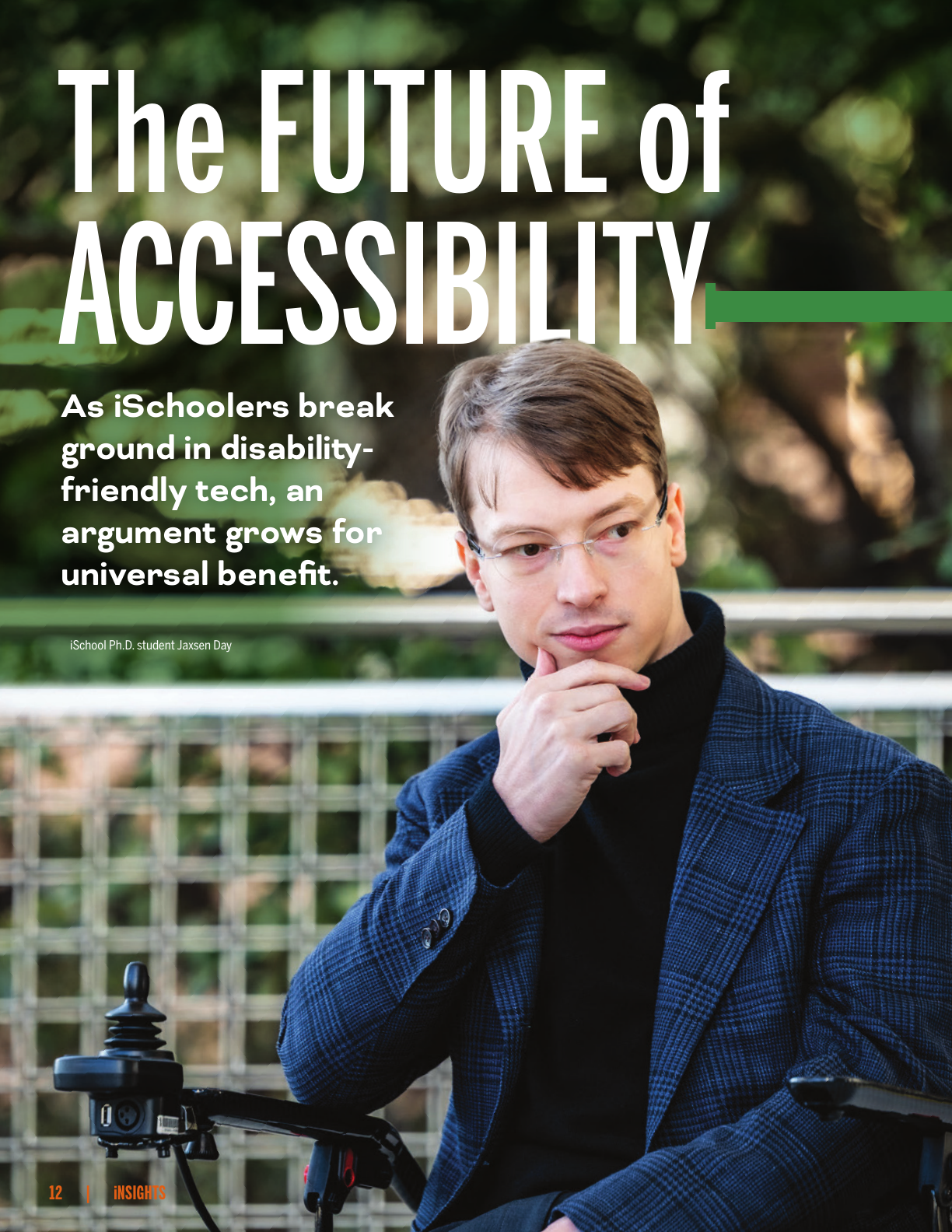
As iSchoolers break ground in disability-friendly tech, an argument grows for universal benefit.
iSchool Ph.D. student Jaxsen Day
Image Descriptions
- Portrait of Jaxsen Day seated outdoors, wearing a blue checked sport coat over a black shirt and resting one hand near his chin.
The Future of Accessibility is Here, continued
These are exciting days for researchers specializing in accessibility. Never before have industry attitudes, legal imperatives and scholarly consensus been so aligned in favor of disability-friendly technology. We are living in a watershed moment for this area of study, and the iSchool is at the forefront.
Here is why everyone, on UT campus and beyond, is embracing accessible tech: In large part, it’s about recognizing that disabled people have historically been unfairly excluded from using certain tools, but it also stems from a growing recognition that choices made with disabled people in mind tend to provide value to a much broader range of users, even giving accessibly designed products an edge in the marketplace.
“We have observed that, if you can address accessibility well in a design, the experience also improves for those who report no disability,” says iSchool professor Andrew Dillon. “You design better for everybody. There’s a universal benefit.”
We at the iSchool also see universal benefit in making our community welcoming to students with disabilities – and in sharing our expertise on university accessibility with other institutions. As we rally researchers across campus and funders around the world to make UT a global beacon of accessible tech, we look to those living with disabilities to help lead the conversation.
A Hard-Won Vision for Inclusivity
Jaxsen Day, a Ph.D. candidate at the iSchool, knows a thing or two about the value of accessible tech. Born with cerebral palsy, Day has vision
challenges that make it difficult to read for long stretches or navigate websites with complex design elements. This can lead to headaches, which have the potential to slow his academic progress.
Since childhood, Day has sought technological solutions: first physical text magnifiers attached to closed-circuit TVs, then clunky early screen-reading software like ZoomText, and now modern reader apps that work seamlessly across most websites. Day’s story is one of both technological and personal advancement — a hopeful trajectory, but by no means an easy path.
“When you’re disabled and you’re working in an environment designed,
The Future of Accessibility is Here, continued
for instance, for somebody with full use of their vision, there is labor before the labor,” Day says.
At UT, Day, who also uses a wheelchair for long distances, can’t help but notice that he is one of few significantly disabled people to advance academically to an elite graduate program, let alone beyond that to a lucrative career. He attributes this scarcity to accessibility challenges.
“If you look at the numbers, the educational attainment rates for the disabled population in the U.S. is pretty low,” he explains. “As a result, many don’t have the greatest job prospects.”
Day’s doctoral research focuses on technological roadblocks impeding disabled people in academia. He can easily identify several just from his day-to-day experience of grad school. He sees PDFs, which resist most screen-reading apps, as “terrible” for accessibility. Library databases, too, are often difficult to navigate for anyone with vision or typing challenges. Day sees hope, however, in emerging technologies to address these shortcomings. “AI tools are changing the way that I can navigate the internet, in terms of finding information,” he says.
For his dissertation, Day has already completed interviews with 28 academic librarians about their experiences assisting students with visual impairments in accessing and interacting with academic reading materials. Next, he plans to add interviews with disabled students about their challenges accessing reading materials and their potential use of AI in academic work.
Day expresses gratitude to the iSchool, especially his advisor, Ken Fleischmann, for being proactive in accommodating him. “Being willing to do the work of figuring out how to make certain communities and environments more accessible is a rare trait, and it’s not something that’s talked about enough,” he says. “Ken has enabled me to do a lot of things that I wouldn’t have previously thought possible.”
Day’s aspiration is to pay that forward, by doing his part to help make the broader world of U.S. academia more accommodating. He is a proponent of universal design, the idea that accessible choices lead to unexpectedly broad-based benefits. He invokes the example of curb cuts at pedestrian crossings, mandated by the Americans with Disabilities Act but now much appreciated by parents with strollers and delivery people with hand trucks.
Day sees accessible technology and accessible research environments paying similarly unforeseen dividends. “The population of the United States is aging,” he points out. “We’re living longer than we ever have. If you build an accessible world, you build a much more seamless and oftentimes a physically safer world.”
No Time to Play
Catch-Up
Though he’s still early in his career, professor Earl Huff, Jr. has already been a part of two technological leaps forward that have demanded new solutions for accessibility. The first was the rapid emergence of learning management systems for remote classrooms during the Covid-19 pandemic. The second was the arrival of generative AI such as large language models.
In 2020, when the pandemic began, Huff was a graduate student at Clemson University just beginning to design a dissertation on accessible classroom technology. He saw in real time how the shift to remote learning was leaving disabled students behind.
“It offered convenience in terms of learning pace and removing geographical barriers, but a lot of the technologies being used
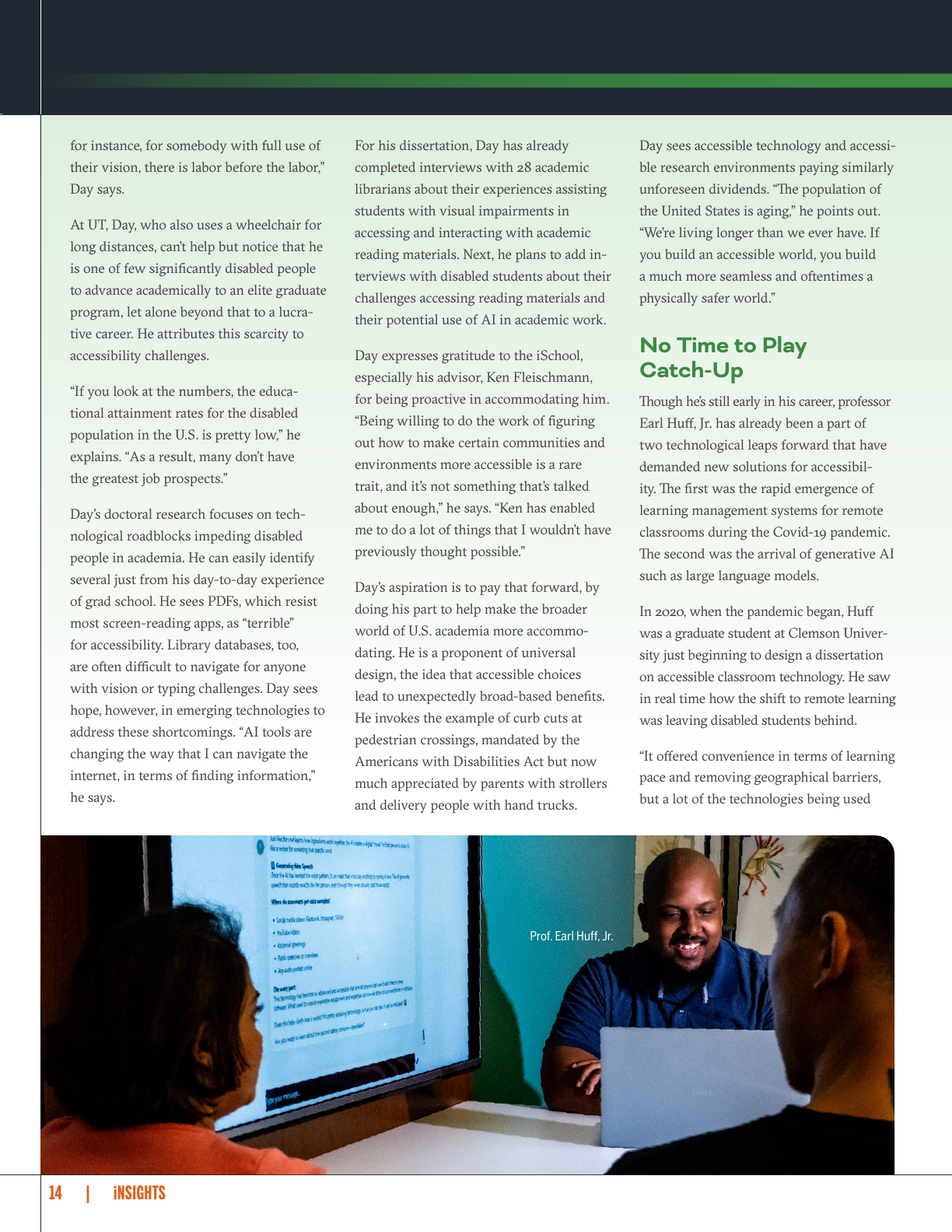
Prof. Earl Huff, Jr.
Image Descriptions
- Earl Huff Jr., wearing a blue polo shirt, smiling at a meeting table with students, a laptop, and a large display screen.
The Future of Accessibility is Here, continued
were not readily accessible, and students with certain disabilities – be it vision, hearing or cognitive – found a lot of challenge,” he explains.
Huff quickly shifted his research focus to evaluating and improving e-learning platforms for disabled populations. His dissertation project involved co-designing a new prototype learning-management system with blind and low-vision K-12 students and their teachers, then testing it in a school.
The feedback was overwhelmingly positive. “It was confirming to know that the work I was doing was something that is greatly needed, and that people were willing to work with me to help address these issues,” he says.
More recently, at the iSchool, Huff, in a joint mentorship with a Computer Science faculty member, advised an information studies master’s student on her thesis to investigate using generative AI to provide descriptive texts for website graphics. “Blind and low-vision people rely on screen readers to describe objects on a website, but oftentimes people who post a graphic forget the alternative text needed so that screen readers can properly describe it,” he explains. “Well, think about the power of an LLM to process an image and produce an appropriate descriptive text.”
His latest project, underway at the REALITY Lab he co-directs at the iSchool, involves AI spambot literacy. Some experts predict a wave of fraud crimes as AI gets better at imitating the voices or written diction of individuals and targets their loved ones for extortion or cash-transfer scams. Here, Huff’s focus is on older adults, who are often viewed as especially susceptible to these advanced forms of phishing and scamming. His project involves teaching AI use with AI, developing a chat bot intervention that helps grow literacy skills.
Huff sees a bright future at UT for research that makes disabled and vulnerable populations a priority. “I see accessibility as a growing area that we look forward to expanding, so that students are more well-rounded and are able to tackle big problems in society – for all people, not just a subset,” he says.
Growing the Accessible-Design Workforce
Prof. John Neumann was a UX manager at Visa when, in 2020, the iSchool approved his graduate-level course proposal for “Accessible User Experience (UX).” The U.S. Supreme Court had just ruled that certain accessibility requirements for brick-and-mortar businesses under the Americans with Disabilities Act also applied to digital
environments. Neumann foresaw a big shift coming in favor of UX designers who take accessibility seriously.
He was right, and the instant popularity of his iSchool course helped to prove it. “As far as we know, it was the first dedicated accessibility course anywhere in the country – it was pioneering,” Neumann says. “The class immediately maxed out. We’ve upped the enrollment fifty percent, and we still have to turn people away.”
Soon, Neumann introduced a similar – and equally popular – course for undergraduates. He attributes the success of the courses to two factors. “It’s the carrot and stick,” he says. “For the students, they want to do some good, help the disabled community. Some corporations do, too. Others need the threat of a lawsuit.”
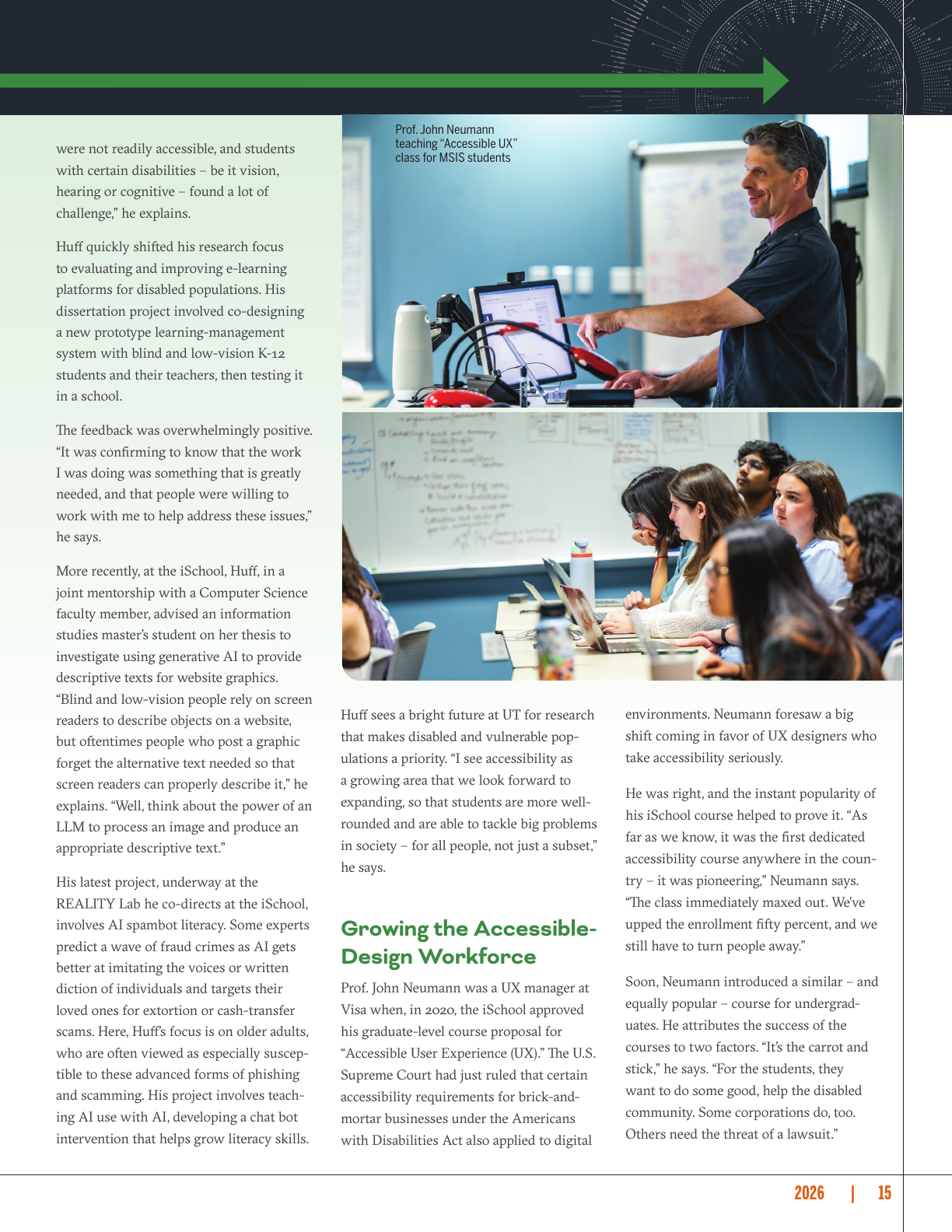
Prof. John Neumann
teaching “Accessible UX”
class for MSIS students
Image Descriptions
- A researcher demonstrating an accessible computer workstation with a red adaptive mouse and other assistive input devices.
- Students seated with laptops in a classroom while an instructor demonstrates technology at the front of the room.
The Future of Accessibility is Here, continued
Both courses begin with an introduction to key concepts in accessible UX, like color contrast, image alternative text and compatibility with screen readers and keyboard navigation. The courses culminate with each student completing a formal Web Content Accessibility Guidelines (WCAG) 2.2 evaluation on a website or digital app.
“The majority of my students will put these evaluations in their portfolios and use them during their job search,” Neumann says. “It’s a great differentiator. I get a lot of feedback from former students that their accessibility work helped get them the interview and successfully separated them from other candidates.”
More than 20 of Neumann’s students have also passed the Certified Professional and Accessibility Core Competencies exam administered by the International Association of Accessibility Professionals, which Neumann proctors and helps prepare them for. Several students have also gained hands-on accessible design experience working with the Digital Accessibility Center (DAC), a recent initiative by Enterprise Technology to improve online accessibility at UT. “We had almost an endless stream of qualified students to support the DAC right out of the gate,” Neumann says.
To Neumann, the accessible design offerings that he has pioneered at the iSchool are not just a matter of idealism or making the world a better place. They are simply necessary elements of a modern education in UX.
“It’s important, if we’re going to offer UX curriculum, that we include accessibility, because it is now part of the work,” he says. “That’s the takeaway: Accessibility is not extra work. It’s part of the work.”
What Starts Here…
UT may be a burgeoning national leader in accessibility and technology, but the goal is not to permanently outstrip other colleges and universities in this regard. Quite the opposite: At the National Disability Center for Student Success (NDCSS), co-directed by iSchool professor Andrew Dillon, the vision is to be an online resource hub for other institutions seeking to improve accessibility practices.
Though housed at UT, the NDCSS is funded with federal grants, and its mission goes far beyond the Forty Acres. “We felt that, by creating this center, we could serve as a focal point for really good research and, furthermore, develop tools and recommended practices that we could push out to universities around the country,” Dillon says.
The NDCSS publishes national reports on disabled college student experiences and on faculty accessibility practices. Its website also hosts a plethora of other shareable guides for university administrators, faculty and staff to consult, from “Why Students Do or Don’t Disclose Disability” to “De-Siloing Mental Health and Disability Resources.”
As the public face of the NDCSS, Dillon is often on camera leading town-hall-style events, in which he facilitates conversations with various experts in the field on best practices for accessibility in higher education. Looking ahead, his next project is to host similar discussions for interactive learning modules and self-study tools.
All NDCSS materials are always free of charge for all users. When he thinks about the potential impact of what the Center offers, Dillon is struck by the magnitude of the accessibility need – and by how much further many of us in academia could be going towards addressing it.
“One in four students in higher education in the US has some kind of disability,” Dillon says. “We’re talking about millions of students. I always say to my colleagues: Every time you look at your class, you have to imagine that one quarter of the students there may be experiencing an accessibility challenge. Are you aware of that? Have you thought about how you might address it? And how you might enable them to disclose it to you, so you can best help them?”
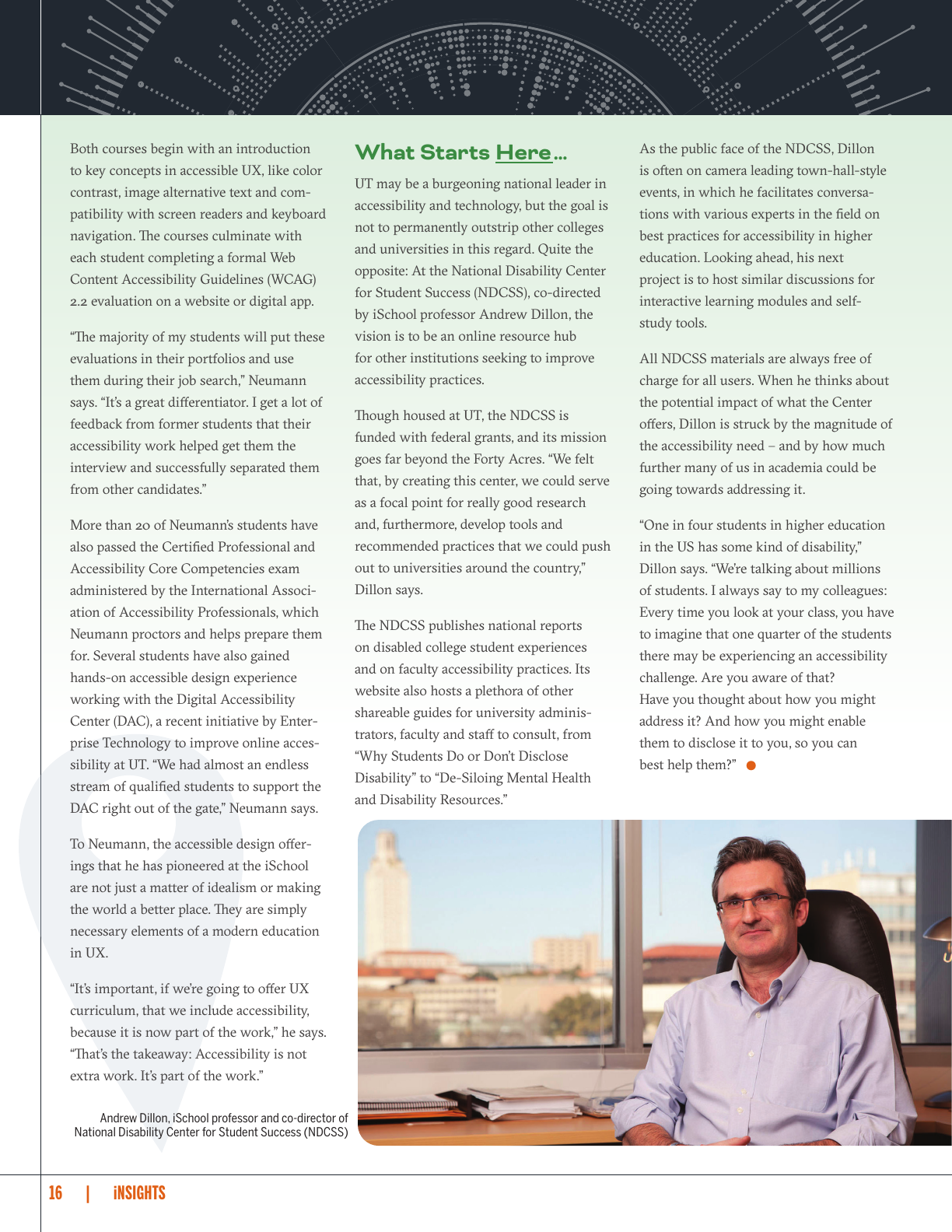
Andrew Dillon, iSchool professor and co-director of
National Disability Center for Student Success (NDCSS)
Image Descriptions
- Portrait of Andrew Dillon seated in an office wearing a light blue shirt, with the UT Tower visible through the window behind him.
Capstone Awards
CAPSTONE AWARD
WINNERS SHOWCASE OUTSTANDING STUDENT RESEARCH
Each spring, the iSchool hosts a Capstone Poster Session featuring over 150 presentations from undergraduate and graduate students alike, ranging from master’s theses and library practica to professional experience projects and focused research reports. These two Dean’s Choice winners from the 2025 Capstone event offer a taste of the exciting student research going on in every corner of the iSchool.
GRADUATE WINNER DEAN’S CHOICE AWARD
Mana Shah MSIS ‘25
While completing her M.S. at the
iSchool, Shah began working for Verveware, a Chicago-based company that offers
user-friendly technology to home care providers. Shah’s winning project, titled “Empowering Care Through Seamless LMS Integration,” recapped her efforts to build better UX for Verveware’s caregiver training offerings.
Shah’s project aims to streamline training and compliance for homecare agencies, ensuring that administrators can easily track progress and that caregivers train on a single system for faster onboarding. She used Figma, a collaborative web application for interface design, to simplify complex workflows for both caregivers and supervisors. Her poster displayed these roadmaps alongside mock-ups of what the user experience might look like on the screen.
The project helped Shah gain industry experience designing for learning management systems (LMS) – that is, software applications that oversee training and education. She credits the iSchool with giving her the tools to take on any UX challenge.
“The iSchool gave me the foundation I needed to transition from software engineering into UX design,” Shah says. “Through supportive faculty, hands-on courses and a collaborative environment, I built the skills and mindset to approach design with confidence. I got to apply everything I learned during my capstone at Verveware, where I led the design of a LMS from the ground up. Taking full ownership — from user research to final handoff — was a defining moment that showed me what it takes to create meaningful, real-world solutions. As they say, ‘What starts here, changes the world’ — and I truly felt that.”
UNDERGRADUATE WINNER DEAN’S CHOICE AWARD
Abigail Stark B.S. ‘25
Stark worked with faculty supervisor Yan Zhang to complete her
capstone project, “Review of Mental
Health Applications & User Experience.” The project seeks to gain deeper understanding of popular mobile applications that claim to help manage mental health and well-being.
After preliminary research on commercially available mental health apps, Stark selected 11 leading apps for review. To assess the market, she completed a uniform audit of each app’s mechanisms and affordances and used Python to extract 660 user reviews from mobile app stores. She ran a qualitative analysis on these reviews using MaxQDA software and is in the process of compiling a final report.
Stark’s initial findings showed that, across the board, the apps seemed to generate too many similar-sounding affirmations, and that some affirmations could be “cheesy,” low-quality and even emotionally harmful. On the bright side, users often remarked that the apps cultivated a positive mindset, facilitated self-growth and inspired in moments of discouragement.
Stark’s findings open questions about quality versus quantity in mobile mental health applications. On her poster, she voiced skepticism that these apps offered real solutions for users struggling with mental health. “Are affirmations an effective long-term mental health fix?” she asked. “Or are they a band-aid solution to mental health?”
Image Descriptions
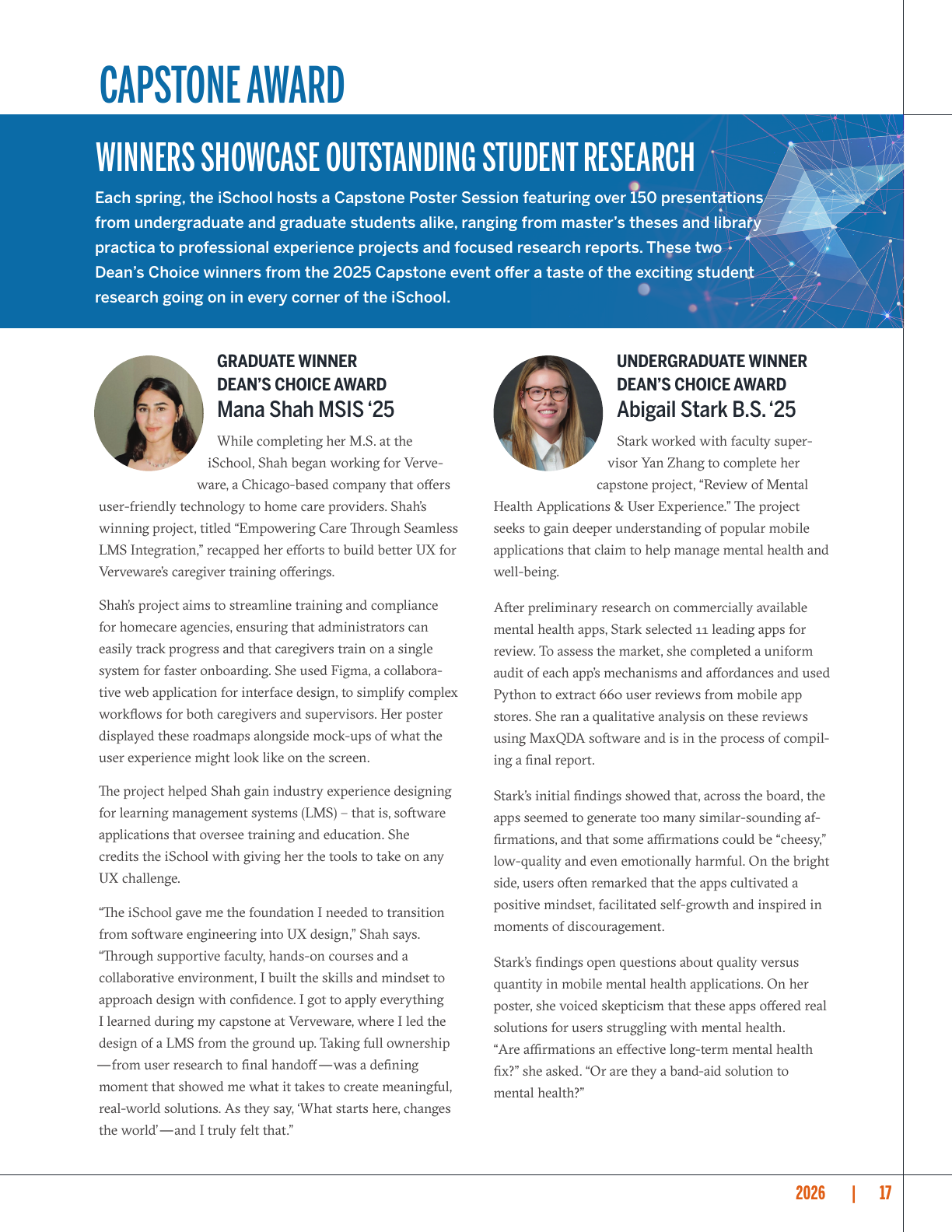
- Headshot of Mana Shah, graduate Dean's Choice Award winner, with dark hair against a neutral green background.
- Headshot of Abigail Stark, undergraduate Dean's Choice Award winner, with blonde hair and glasses.
Alumni News: Libby Peterek
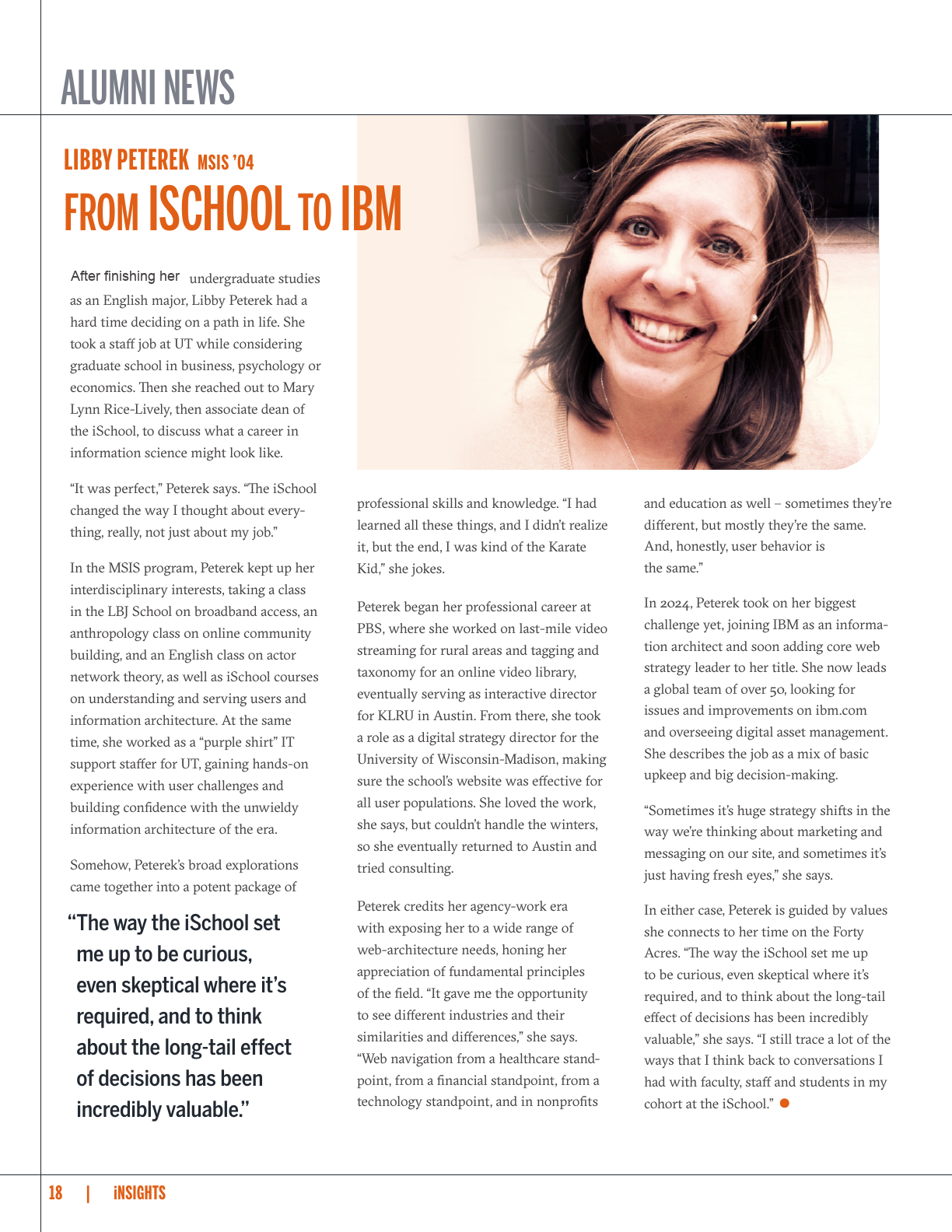
After finishing her undergraduate studies as an English major, Libby Peterek had a hard time deciding on a path in life. She took a staff job at UT while considering graduate school in business, psychology or economics. Then she reached out to Mary Lynn Rice-Lively, then associate dean of the iSchool, to discuss what a career in information science might look like.
“It was perfect,” Peterek says. “The iSchool changed the way I thought about everything, really, not just about my job.”
In the MSIS program, Peterek kept up her interdisciplinary interests, taking a class in the LBJ School on broadband access, an anthropology class on online community building, and an English class on actor network theory, as well as iSchool courses on understanding and serving users and information architecture. At the same time, she worked as a “purple shirt” IT support staffer for UT, gaining hands-on experience with user challenges and building confidence with the unwieldy information architecture of the era.
Somehow, Peterek’s broad explorations came together into a potent package of
professional skills and knowledge. “I had learned all these things, and I didn’t realize it, but the end, I was kind of the Karate Kid,” she jokes.
Peterek began her professional career at PBS, where she worked on last-mile video streaming for rural areas and tagging and taxonomy for an online video library, eventually serving as interactive director for KLRU in Austin. From there, she took a role as a digital strategy director for the University of Wisconsin-Madison, making sure the school’s website was effective for all user populations. She loved the work, she says, but couldn’t handle the winters, so she eventually returned to Austin and tried consulting.
Peterek credits her agency-work era with exposing her to a wide range of web-architecture needs, honing her appreciation of fundamental principles of the field. “It gave me the opportunity to see different industries and their similarities and differences,” she says. “Web navigation from a healthcare standpoint, from a financial standpoint, from a technology standpoint, and in nonprofits
and education as well – sometimes they’re different, but mostly they’re the same. And, honestly, user behavior is the same.”
In 2024, Peterek took on her biggest challenge yet, joining IBM as an information architect and soon adding core web strategy leader to her title. She now leads a global team of over 50, looking for issues and improvements on ibm.com and overseeing digital asset management. She describes the job as a mix of basic upkeep and big decision-making.
“Sometimes it’s huge strategy shifts in the way we’re thinking about marketing and messaging on our site, and sometimes it’s just having fresh eyes,” she says.
In either case, Peterek is guided by values she connects to her time on the Forty Acres. “The way the iSchool set me up to be curious, even skeptical where it’s required, and to think about the long-tail effect of decisions has been incredibly valuable,” she says. “I still trace a lot of the ways that I think back to conversations I had with faculty, staff and students in my cohort at the iSchool.”
ALUMNI NEWS
LIBBY PETEREK
MSIS ’04
From iSchool to IBM
“ The way the iSchool set
me up to be curious, even skeptical where it’s required, and to think about the long-tail effect of decisions has been incredibly valuable.”
Andrea Cato
Image Descriptions
- Portrait of Libby Peterek smiling against a light background.
Alumni News: Crystal Paull
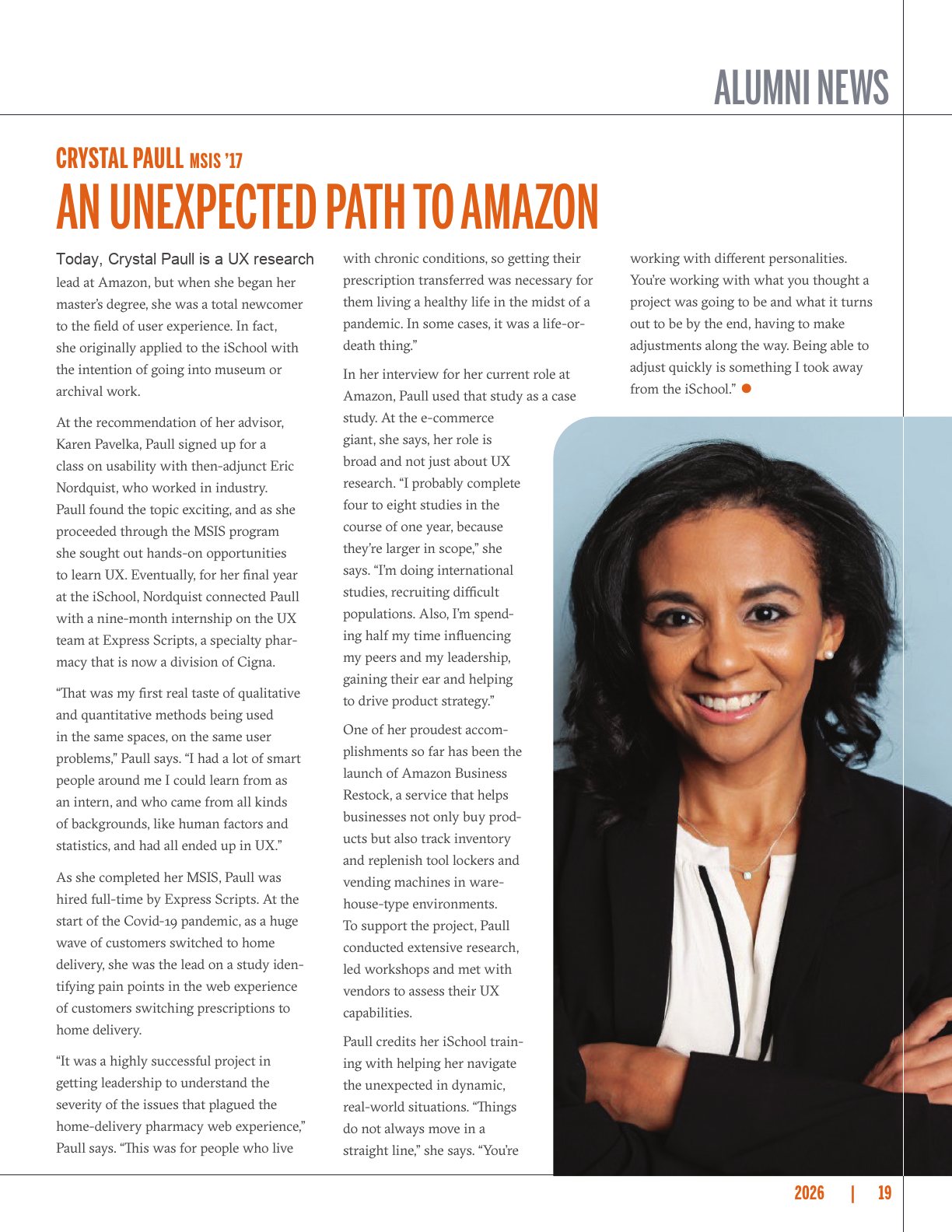
Today, Crystal Paull is a UX research lead at Amazon, but when she began her master’s degree, she was a total newcomer to the field of user experience. In fact, she originally applied to the iSchool with the intention of going into museum or archival work.
At the recommendation of her advisor, Karen Pavelka, Paull signed up for a class on usability with then-adjunct Eric Nordquist, who worked in industry. Paull found the topic exciting, and as she proceeded through the MSIS program she sought out hands-on opportunities to learn UX. Eventually, for her final year at the iSchool, Nordquist connected Paull with a nine-month internship on the UX team at Express Scripts, a specialty pharmacy that is now a division of Cigna.
“That was my first real taste of qualitative and quantitative methods being used in the same spaces, on the same user problems,” Paull says. “I had a lot of smart people around me I could learn from as an intern, and who came from all kinds of backgrounds, like human factors and statistics, and had all ended up in UX.”
As she completed her MSIS, Paull was hired full-time by Express Scripts. At the start of the Covid-19 pandemic, as a huge wave of customers switched to home delivery, she was the lead on a study identifying pain points in the web experience of customers switching prescriptions to home delivery.
“It was a highly successful project in getting leadership to understand the severity of the issues that plagued the home-delivery pharmacy web experience,” Paull says. “This was for people who live
with chronic conditions, so getting their prescription transferred was necessary for them living a healthy life in the midst of a pandemic. In some cases, it was a life-or-death thing.”
In her interview for her current role at Amazon, Paull used that study as a case study. At the e-commerce giant, she says, her role is broad and not just about UX research. “I probably complete four to eight studies in the course of one year, because they’re larger in scope,” she says. “I’m doing international studies, recruiting difficult populations. Also, I’m spending half my time influencing my peers and my leadership, gaining their ear and helping to drive product strategy.”
One of her proudest accomplishments so far has been the launch of Amazon Business Restock, a service that helps businesses not only buy products but also track inventory and replenish tool lockers and vending machines in warehouse-type environments. To support the project, Paull conducted extensive research, led workshops and met with vendors to assess their UX capabilities.
Paull credits her iSchool training with helping her navigate the unexpected in dynamic, real-world situations. “Things do not always move in a straight line,” she says. “You’re
working with different personalities. You’re working with what you thought a project was going to be and what it turns out to be by the end, having to make adjustments along the way. Being able to adjust quickly is something I took away from the iSchool.”
ALUMNI NEWS
CRYSTAL PAULL
MSIS ’17
AN UNEXPECTED PATH TO AMAZON
Image Descriptions
- Portrait of Crystal Paull smiling in a black blazer and white blouse.
A Bright Future Ahead
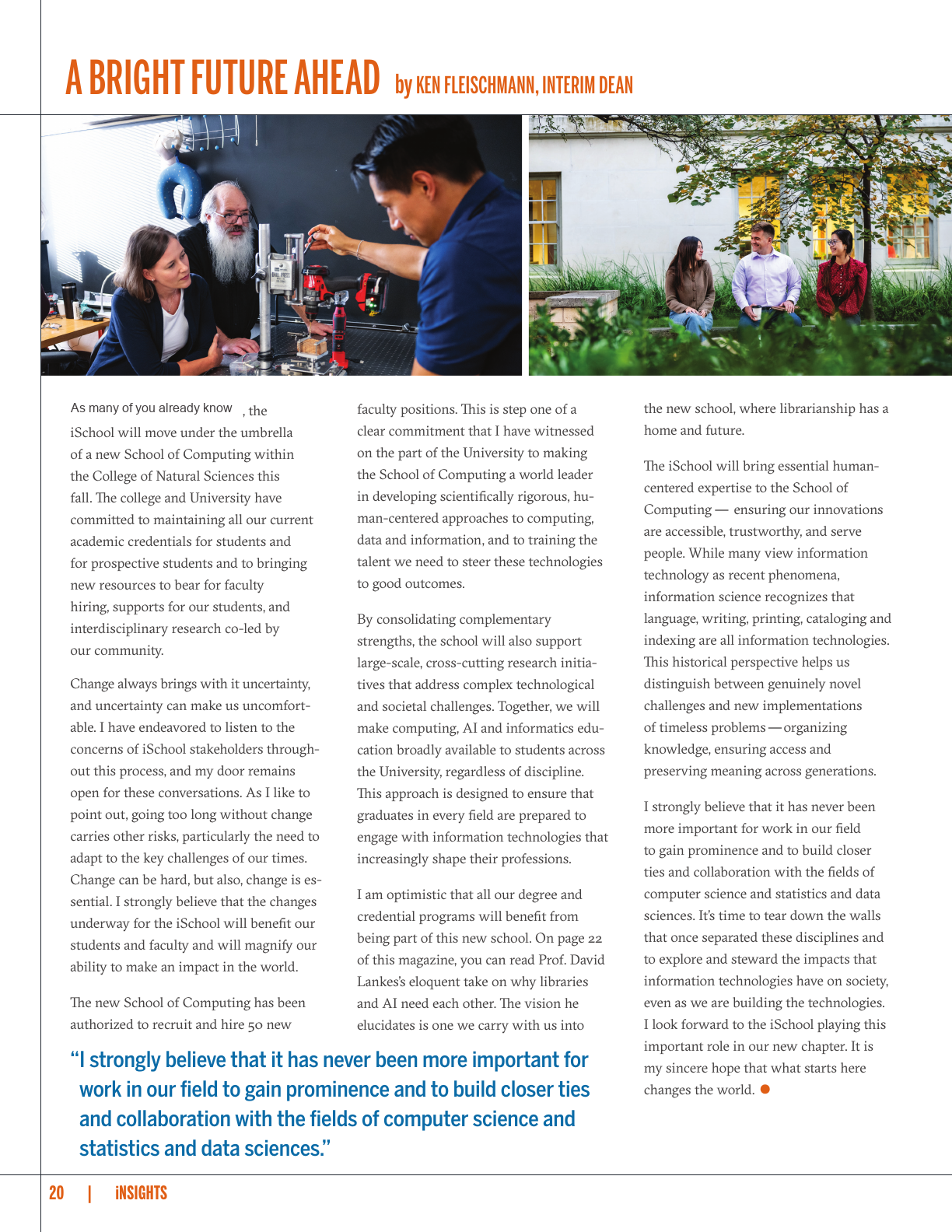
As many of you already know, the iSchool will move under the umbrella of a new School of Computing within the College of Natural Sciences this fall. The college and University have committed to maintaining all our current academic credentials for students and for prospective students and to bringing new resources to bear for faculty hiring, supports for our students, and interdisciplinary research co-led by our community.
Change always brings with it uncertainty, and uncertainty can make us uncomfortable. I have endeavored to listen to the concerns of iSchool stakeholders throughout this process, and my door remains open for these conversations. As I like to point out, going too long without change carries other risks, particularly the need to adapt to the key challenges of our times. Change can be hard, but also, change is essential. I strongly believe that the changes underway for the iSchool will benefit our students and faculty and will magnify our ability to make an impact in the world.
The new School of Computing has been authorized to recruit and hire 50 new
faculty positions. This is step one of a clear commitment that I have witnessed on the part of the University to making the School of Computing a world leader in developing scientifically rigorous, human-centered approaches to computing, data and information, and to training the talent we need to steer these technologies to good outcomes.
By consolidating complementary strengths, the school will also support large-scale, cross-cutting research initiatives that address complex technological and societal challenges. Together, we will make computing, AI and informatics education broadly available to students across the University, regardless of discipline. This approach is designed to ensure that graduates in every field are prepared to engage with information technologies that increasingly shape their professions.
I am optimistic that all our degree and credential programs will benefit from being part of this new school. On page 22 of this magazine, you can read Prof. David Lankes’s eloquent take on why libraries and AI need each other. The vision he elucidates is one we carry with us into
the new school, where librarianship has a home and future.
The iSchool will bring essential human-centered expertise to the School of Computing — ensuring our innovations are accessible, trustworthy, and serve people. While many view information technology as recent phenomena, information science recognizes that language, writing, printing, cataloging and indexing are all information technologies. This historical perspective helps us distinguish between genuinely novel challenges and new implementations of timeless problems — organizing knowledge, ensuring access and preserving meaning across generations.
I strongly believe that it has never been more important for work in our field to gain prominence and to build closer ties and collaboration with the fields of computer science and statistics and data sciences. It’s time to tear down the walls that once separated these disciplines and to explore and steward the impacts that information technologies have on society, even as we are building the technologies. I look forward to the iSchool playing this important role in our new chapter. It is my sincere hope that what starts here changes the world.
“ I strongly believe that it has never been more important for
work in our field to gain prominence and to build closer ties and collaboration with the fields of computer science and statistics and data sciences.”
Image Descriptions
- People gathered around an AI-powered welding simulator or smart hand tools setup in a lab.
- Three people seated outdoors on a bench near campus landscaping and a light-colored building.
Shaping the Future of Information Science
• STUDENT SUCCESS:
Donor-funded scholarships and fellowships enable talented students from various backgrounds to pursue their education without financial barriers. Your contributions also help students attend conferences, obtain certifications and build relationships with industry experts.
• INNOVATIVE RESEARCH:
Donor support fuels projects that address critical
issues such as accessibility and inclusive design, misinformation, digital equity and data privacy. By investing in our research initiatives, you are supporting advancements in technology, policy and practice that benefit society at large.
• FACULTY EXCELLENCE:
Donor gifts support faculty development, ensuring
that our faculty can continue to excel in their teaching and research. This attracts top talent to the iSchool, further enhancing our reputation and the quality of education we provide.
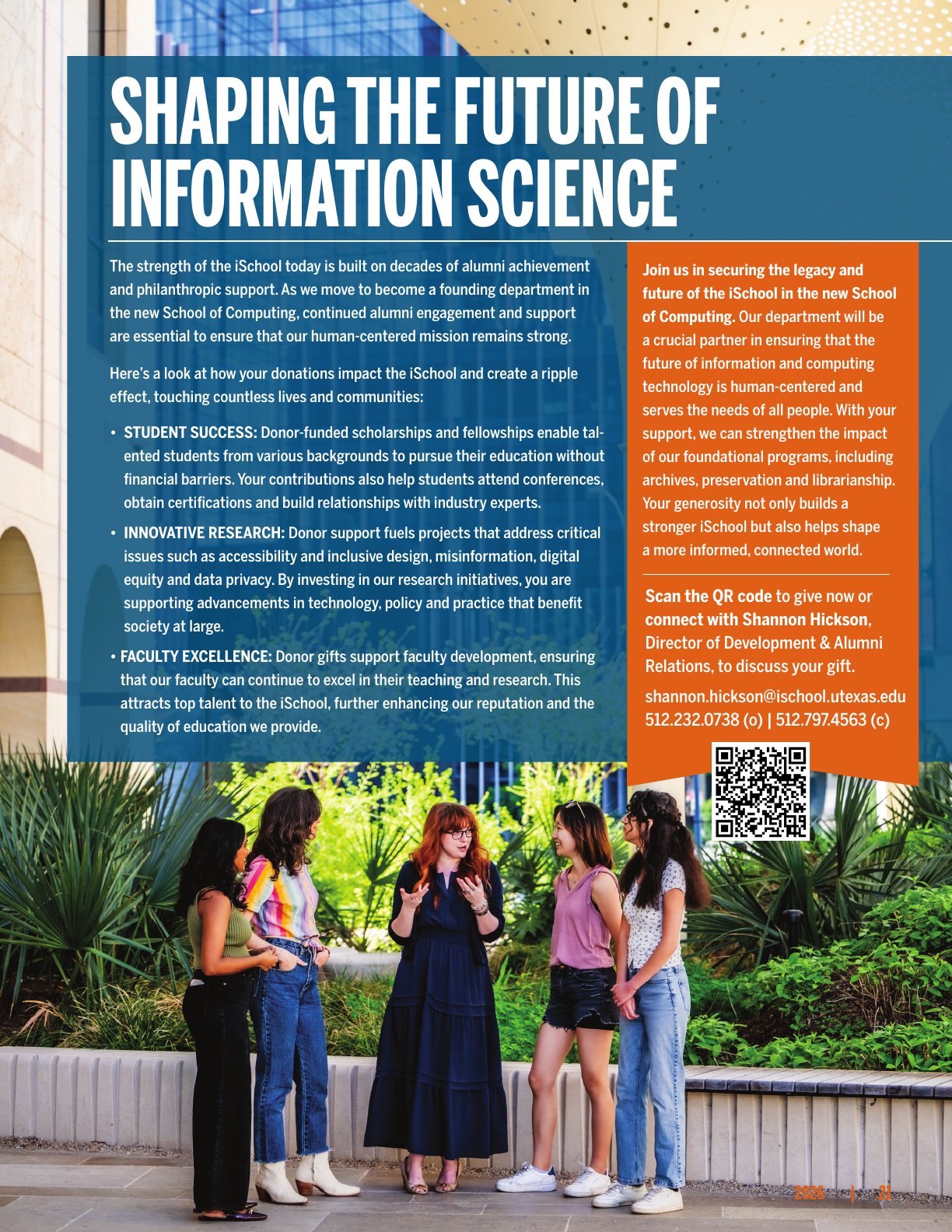
The strength of the iSchool today is built on decades of alumni achievement and philanthropic support. As we move to become a founding department in the new School of Computing, continued alumni engagement and support are essential to ensure that our human-centered mission remains strong.
Here’s a look at how your donations impact the iSchool and create a ripple effect, touching countless lives and communities:
Join us in securing the legacy and future of the iSchool in the new School of Computing.
Our department will be
a crucial partner in ensuring that the future of information and computing technology is human-centered and serves the needs of all people. With your support, we can strengthen the impact of our foundational programs, including archives, preservation and librarianship. Your generosity not only builds a stronger iSchool but also helps shape a more informed, connected world.
Scan the QR code to give now or connect with Shannon Hickson
,
Director of Development & Alumni Relations, to discuss your gift.
shannon.hickson@ischool.utexas.edu 512.232.0738 (o) | 512.797.4563 (c)
Image Descriptions
- Five iRISE students talking outdoors near the School of Information, with a blue overlay and orange QR-code banner above them.
- QR code for updating contact information with the School of Information.
The Humans in the Loop
David Lankes, the iSchool’s Virginia and Charles Bowden Professor of Librarianship, is a busy man these days, traveling the world to discuss his recent book, “Triptych: Death, AI, and Librarianship.” Ahead of 2026 dates in England, Scotland, and the Netherlands, Lankes spoke to us on his way back from Sao Paolo, Brazil to expound on the vision he’s been sharing of the vital role of librarianship in the age of artificial intelligence.
Triptych
takes on the epidemic of deaths of despair in the United
States and asks how libraries can be part of a solution – especially in the context of emerging AI and employment upheavals. The book builds on Lankes’s long resume as a leader in envisioning the library of the future. He recently completed a funded study comparing the uses of AI at 19 state libraries around the U.S.
“This is a topic I’ve been talking about for a decade,” Lankes says. “It’s a conversation I’ve been part of around the world, looking at not only how AI will impact the field of librarianship, but how librarianship can help shape AI to be more trusted and more useful moving forward.”
ARBITERS OF TRUST AND CREDIBILITY
The title of “Triptych” refers to a three-paneled artwork that tells a story. Likewise, his vision for libraries the age of AI emphasizes three interlocking roles. The first role is as intermediaries between the public and AI systems, helping develop an informed understanding of when AI can be useful (and when it’s not ready), when it’s trustworthy (and when it must be taken with a grain of salt), and how it might be harnessed for our needs.
“As our communities are dealing with the rapid shifts in trust that AI is bringing on, they need a trusted agent, a trusted place where they can go to dream, dread and deconstruct,” Lankes says. That place, he argues, should be the library.
Ordinary people need a chance to interact with AI systems – including premium, subscription-only options – and test their ambitions against these emerging capacities. They also need to experience what’s scary about AI systems, including displays of talents that might eventually replace their own human skills in the job market. Above all, people need to experiment until they fully understand what these systems are capable of.
Through all of this, people also need knowledgeable human guidance. It’s Lankes’s hope that, as libraries serve more and more as laboratories for human use of AI, that librarians are appreciated by industry as vital to discussions of AI system designs and goals. “Librarians need to be part of that conversation to meet their mission, and AI developers and builders need librarians be part of it, to talk about trustworthiness and mitigating harm,” Lankes says.
As universities reorganize resources and academic units to encourage collaboration around the emergence of AI, librarians-in-training have a key role to play, enriching the work of computer and data scientists with feedback on user trust, harm mitigation, and how well the public’s information needs are being served. “Librarians are the humans in the loop,” Lankes says.
CUSTODIANS OF DATA INTEGRITY
For librarians and archivists, being “the humans in the loop” goes beyond guiding other humans confronting the AI revolution. A second key role, Lankes says, is to ensure that the data and raw materials used by advanced computer systems are of high quality – not recycled, misused or poorly attributed slop.
“You can’t run good algorithms on crappy data,” Lankes says. “And when you talk about data quality, data integrity, you’re talking about the core of what libraries and archives have asked
Image Descriptions
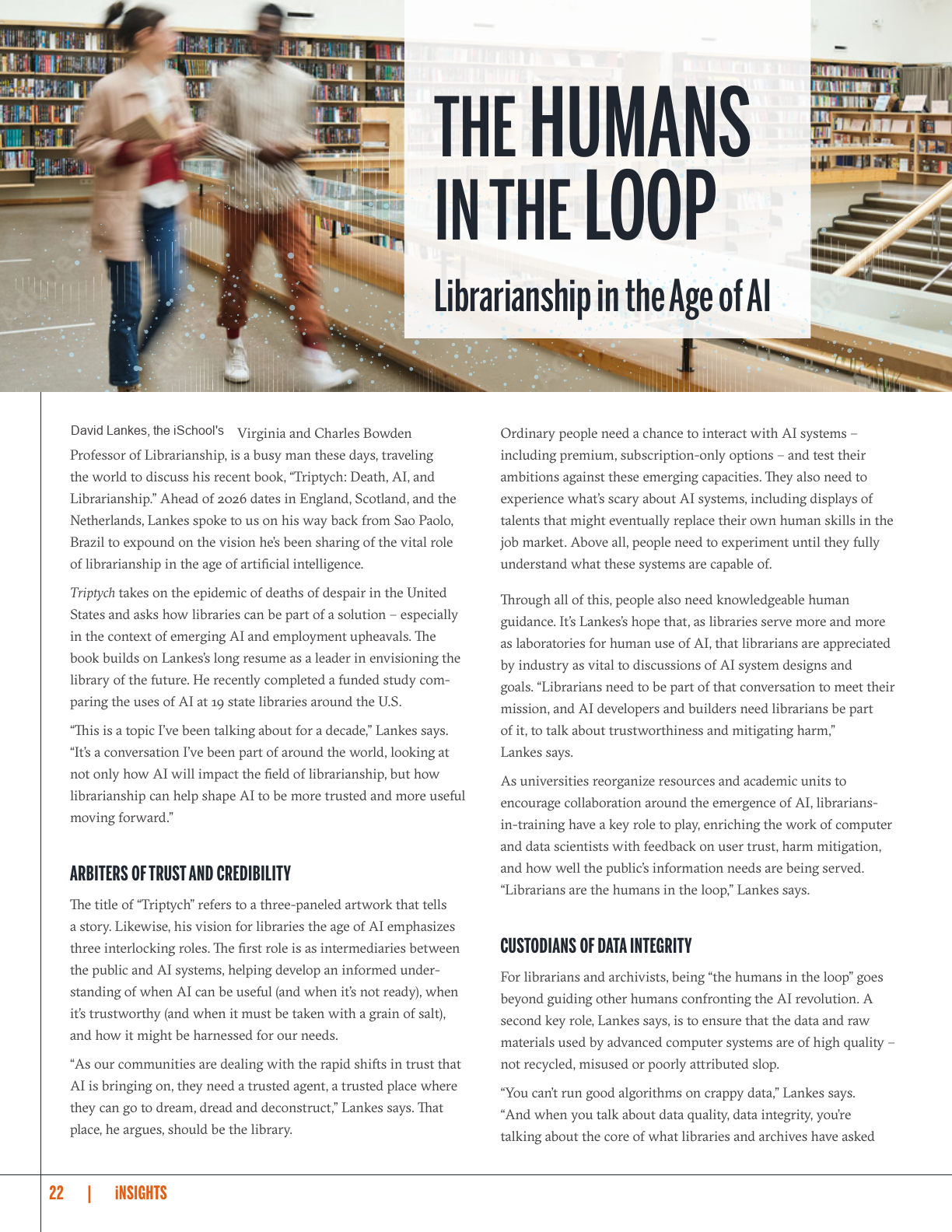
- Two people walking through a bright library with bookshelves and railings in the background.
The Humans in the Loop, continued
forever, both in physical form and, increasingly, in digital form: How do we assure that this data is preserved, is clean, is accessible, is useful?”
In a world where information is passed from algorithm to algorithm at inhuman speed, often subject to new interpretation and recapitulation with each new use, it can be easy to jumble sources or to confuse what exactly certain language or numbers refer to. It has long been the job of librarians and archivists to be resident experts in any community – local, academic, government or corporate – on questions of information provenance, quality, organization and appropriate use. Lankes anticipates this role becoming only more crucial in the coming years.
“These systems depend increasingly not just on algorithms, but on data and collections,” Lankes says. “And so how those collections and data sets and materials are organized, located, described, is essential to success.”
The value-add of librarians could go even further, into reporting back to the architects of AI systems how algorithms are being used in the real world, whether by researchers or ordinary people. This is where the field of information science brushes up against that of user experience design – both career tracks served by the iSchool, incidentally.
“On one end, the systems have to be fed, and library science and archives help with what they’re being fed,” he says. “On the other end, these systems and algorithms are being used, and knowing about the environments in which they’re being used helps to influence and improve the system.”
COMMUNITY PARTNERS
Much of
“
Triptych” is concerned with the serious consequences
of technological and economic upheaval on Main Street. As ordinary people try to adjust to rapid changes, the library will be one of the key places people go to adapt, whether they are seeking new employment, professional advancement or entrepreneurial opportunity.
“It’s a place where people go to do resume development, where they apply to school, where they find a space to work, where they have not only a trusted environment and trusted resources, but
trusted people, in the form of librarians and archivists, to help them through that process,” Lankes says.
The experience of those affected by technological changes – both for the better (enhanced ability to pursue learning or other fulfilling pursuits) or for the worse (loss of job, sense of purpose or social connection) – is part of the emerging story of the era of AI. Those who study people’s use of information, including on-the-ground librarians, are at the forefront of tracking this transformation and feeding findings back into building better systems.
“If you’re going to talk about technologies that are going to change the culture, you’d better understand culture,” Lankes says. “How do you examine it? How do you document it? How do you enrich it?”
Above all, Lankes urges future librarians, and the schools that train them, not to succumb to a backward-looking vision based on how libraries appeared to us when we were young, as places full of treasured objects. What libraries actually do has always exceeded merely hosting collections. In the age of AI, libraries will succeed by continuing to fulfill their core mission, which is unchanged: Libraries must steward information access for the betterment of the communities they serve.
“It’s okay for a 10-year-old to see the library as a bunch of stuff,” Lankes says. “But as adults and as scholars, we need to understand that its true instrumentation is as essential community infrastructure – to help people use information in a positive way, to get smarter, to make smarter decisions.”
“If you’re going to talk about technologies that are going to change the
culture, you’d better understand culture. How do you examine it? How
do you document it? How do you enrich it?”
–PROF. DAVID LANKES
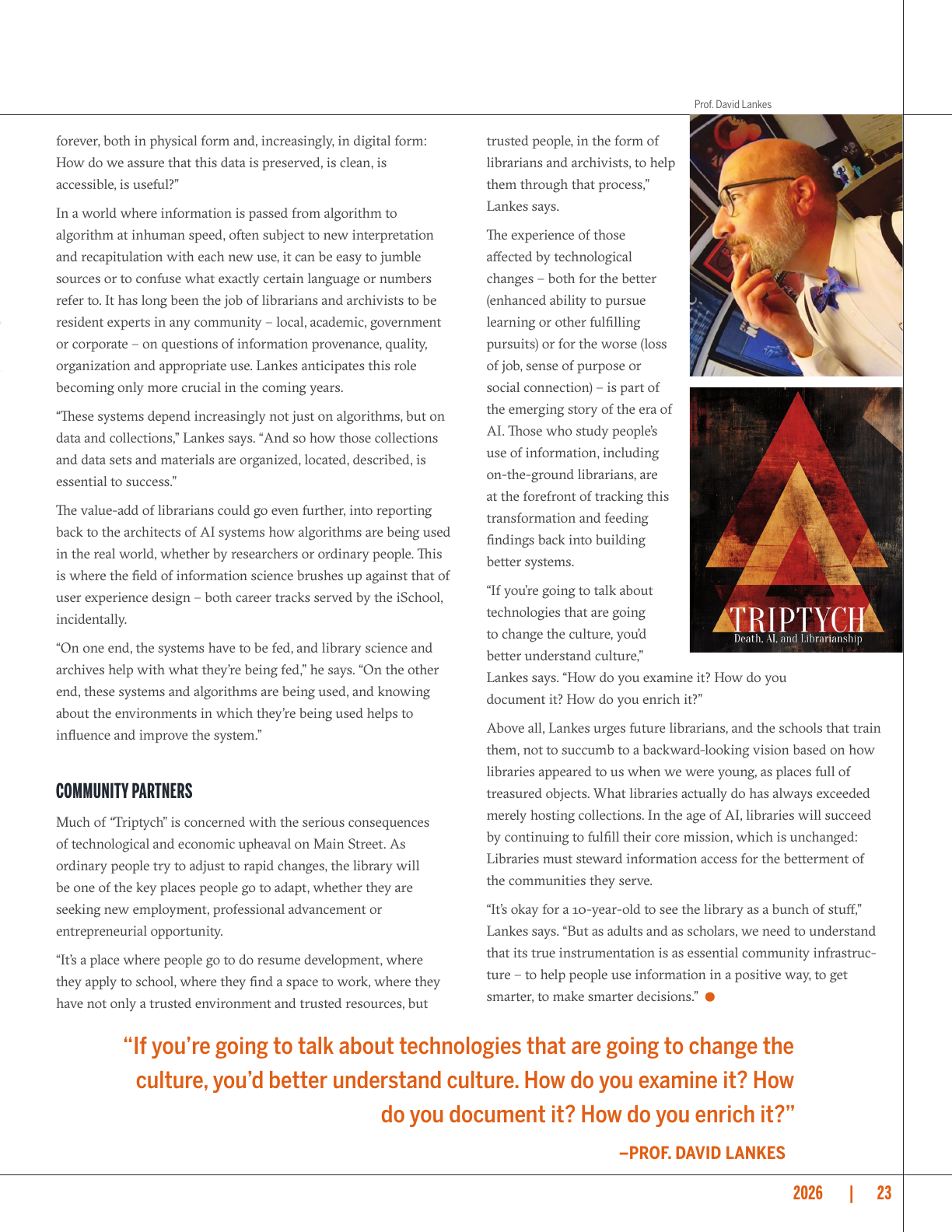
Prof. David Lankes
Image Descriptions
- Portrait of Professor David Lankes wearing glasses, a white shirt, suspenders, and a patterned bow tie.
- Book cover for Triptych: Death, AI, and Librarianship, with a red and gold triangular design on a dark background.
Collaborating for Impact
Collaborating for Impact
School of Information Research Partners
At the iSchool, we value interdisciplinary collaboration, public service, building connections with industry, and fostering real-world experience for our students. Below are just a few examples of iSchool faculty research partnerships with nonprofits,
National Disability Center for Student Success
Andrew Dillon and Earl Huff
Established in 2023, the National Disability Center for Student Success (NDCSS) provides comprehensive and actionable research to support disabled student experiences and achievement after high school. iSchool professor Andrew Dillon serves on the Center’s leadership team and is currently developing a course module which covers practical steps for faculty to take in addressing accessibility in their work as educators. Earl Huff, Jr. is part of the faculty cadre for the Center and mentors student fellows on research projects. Currently, Huff is the lead on a project examining how postsecondary students with disabilities leverage AI technologies during their study to improve accessibility in their learning. This project is in collaboration with the Digital Accessibility Center (DAC), Ken Fleischmann, and his Ph.D. student, Jaxsen Day.
See story on page 12.
Austin State Hospital
Sarah Norris
Students in Sarah Norris’s “Planning and Understand Exhibits” class completed an exhibit with artifacts provided by Austin State Hospital. The exhibit, titled “Life, Labor, and Legacy: The Austin State Hospital,” included historical medical equipment, personal belongings of former residents and resident-created artwork. Established in 1856, ASH followed the Kirkbride model of patient support, creating a wide-ranging and self-sustaining community with its own dairy farm, ice factory, sewing and tailor shop, artesian wells and gardens. Students worked to incorporate both institutional and patient perspectives into the exhibit, conducting research at the Austin History Center, Briscoe Center for American History, Texas Archival Resources Online and others.
Image Descriptions
- A woman in a blue shirt holding a dog.
- Headshot of a man wearing glasses.
- Headshot of a man in a blue suit jacket and white shirt.
- A man speaking at a podium in front of a large building.
- Headshot of a woman wearing a black dress and green necklace.
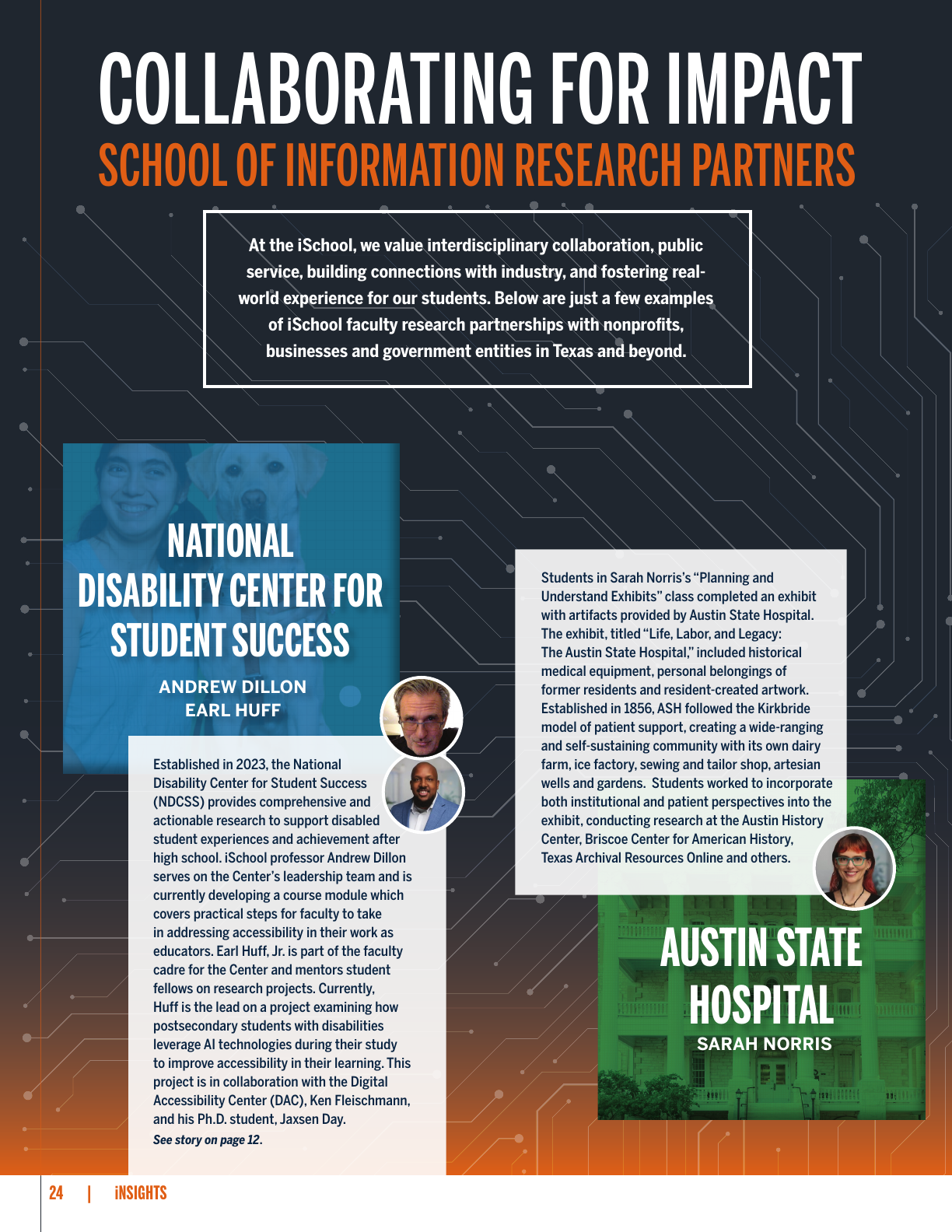
Collaborating for Impact, continued
Austin Public Library
David Lankes, Soo Young Rieh, and Ken Fleischmann
A team of doctoral students led by Qianzi Cao and iSchool faculty worked with the Austin Public Library to explore how ready library staff was for AI. The study surveyed Austin Public Library staff in March 2025 to assess AI readiness, attitudes and concerns. The majority felt unprepared for AI implementation, with data privacy, content accuracy and ethical bias ranking as top concerns. Key findings were that hands-on experience with AI correlated with more positive attitudes and that self-reported confidence predicted readiness more than prior use or beliefs alone. This suggests that supported exploration rather than top-down promotion is the most effective path forward. Surveys and focus groups led to a day-long professional development workshop with the whole staff, from security to department leaders.
Wikimedia Foundation
Hanlin Li
In July of 2025, iSchool professor Hanlin Li received a grant from the Wikimedia Research Fund for her proposal “Informing Memory Institutions and Humanities Researchers of the Broader Impact of Open Data Sharing via Wikidata.” The grant involves both outreach to GLAM institutions (galleries, libraries, archives and museums) and the proposed creation of a tool to help facilitate the use of Wikidata by such organizations. Wikidata is a collaboratively edited, open-source, document-oriented database featuring over 1.6 billion entries. It is increasingly a key resource for human efforts to gather non-paywalled, well-indexed and trustworthy information, as well as for cutting-edge algorithmic models seeking the same. Li’s grant-funded project aims to deliver an open, free tool for memory institutions.
Austin Community College
Brian McInnis and Ken Fleischmann
Interim Dean and Chair Designate Ken Fleischmann leads the Good Systems Smart Hand Tools project which has partnered with the Welding Technology department at ACC to develop an AI-powered welding simulator. This partnership helped Good Systems researchers to develop tools that truly serve the needs of real students and instructors.
See story on page 4.
OpenAlex
James Howison
OpenAlex is a fully open-access bibliographic scholarly graph providing access to metadata and full text of articles. Prof. James Howison is currently working with the organization on a project aimed at increasing the visibility of software in science, detecting software mentions in papers and linking to software repositories. This project builds on the SoftCite dataset and model developed at the School of Information, where over 30 UT and Huston Tillotson students annotated scientific papers while learning about computational research and challenges of incentives for software work in science.
Image Descriptions
- Exterior view of a large institutional building with many windows and a brown roof.
- Headshot of a bearded man wearing glasses, a white shirt, suspenders, and a bow tie.
- Wikimedia Foundation logo.
- Headshot of Hanlin Li wearing glasses and a blue suit jacket.
- Headshot of a bearded man wearing glasses and smiling.
- Headshot of a woman wearing a gray shirt.
- Exterior view of a large building with a brown roof and white wall.
- Colorful diagram with words including information, country, industry, and behavior connected in a network-like layout.
- Headshot of James Howison wearing a colorful jacket and smiling.
- Headshot of a man wearing a blue and white shirt.
- Headshot of a bearded man wearing glasses and smiling.
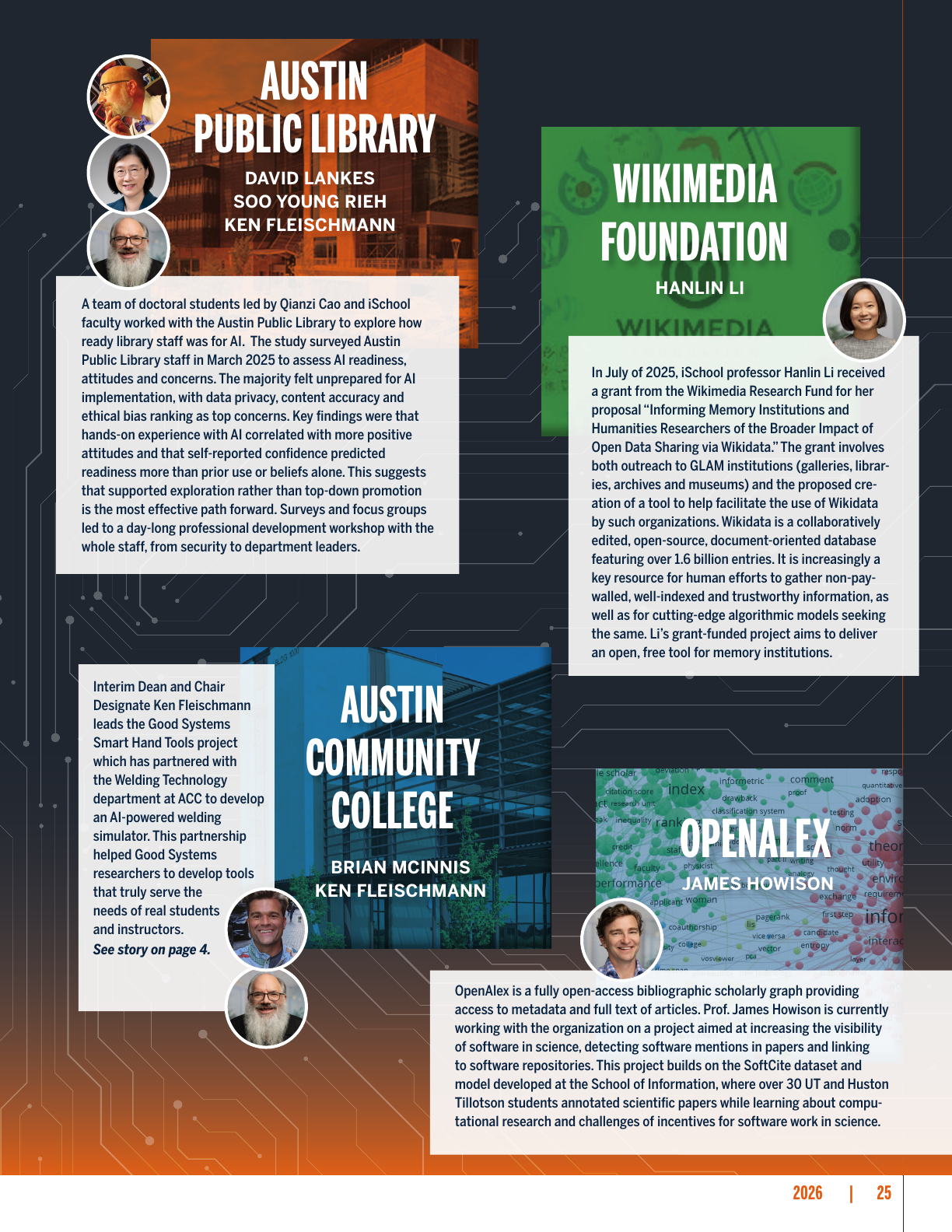
Support the iSchool
The iSchool is at an important juncture as we join the new School of Computing in Fall 2026. We want our alumni, partners and the broader iSchool family along for the ride as we navigate new opportunities, preserve and grow our programs, and work to better realize our mission within this new context. Please
update your contact
information
so that we don’t lose touch during this
crucial and exciting phase.
Scan the QR code to
update your contact information today!
STAY CONNECTED
GUIDE US FORWARD
We’re facing
big changes.
Help steward
our
future
.
1616 Guadalupe, Suite 5.202 Austin, Texas 78701-1213
Image Descriptions
- QR code for updating contact information with the School of Information.